
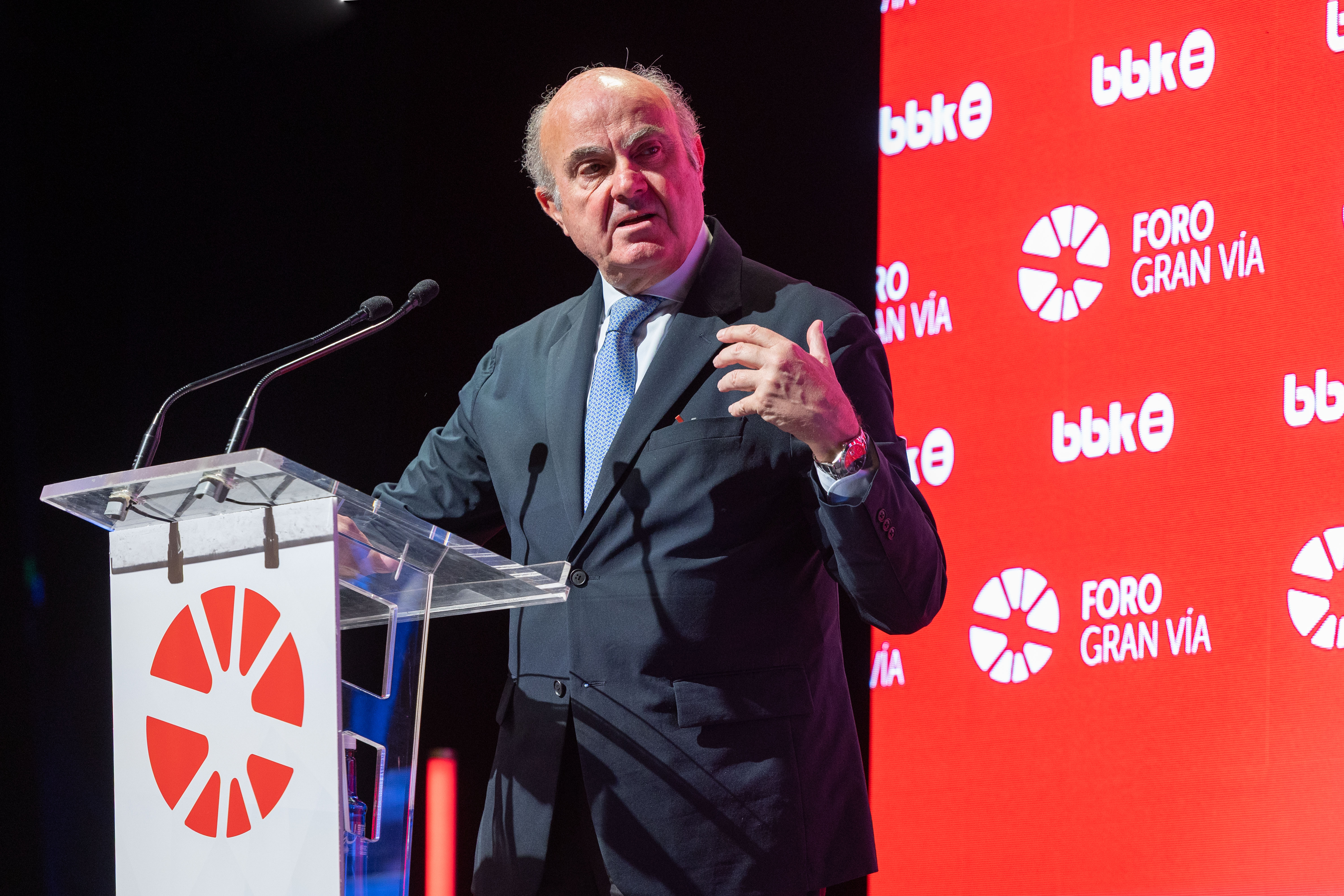
By Marta Vilar – MADRID (Econostream) – European Central Bank Vice President Luis de Guindos said on Wednesday that in principle the war involving Iran is likely to have a negative impact on economic growth while also potentially increasing risks to inflation.
Speaking at the 32nd Encuentro del Sector Financiero organized by ABC and Deloitte in Madrid, de Guindos said that the Middle East conflict had introduced “a wedge of volatility in a world that was already complex from the point of view of the international context, and makes projections much more difficult.”
The ECB needed to develop scenario analyses ranging from a more benign outcome, with a moderate impact on the outlook, to a more severe one, given that the current level of uncertainty was very high, he said.
However, de Guindos noted that financial markets, which had been trading at very high valuation levels, sometimes amplified the potential effects of geopolitical and economic turbulence, adding that people should keep a cool head and avoid “overreacting.”
“For the moment, we have not seen any situation of liquidity problems in any of the markets, but there is a potential risk that we have to analyze,” he added.
When assessing the risks posed by the conflict, he said it was important to consider the previous state of the European economy, which had been performing well.
“It was behaving better than we expected, with growth around 1.5%,” he said, adding that risks had been “balanced”, while inflation had been slightly below the 2% target.
Related articles:
- ECB’s Kazāks: Rate Hike Needed if Energy Shock Risks Lifting Inflation Expectations
- ECB’s Villeroy: No Need to Raise Rates Now, But “Won’t Let Inflation Settle In”
- ECB’s Nagel: If Energy Price Surge Translates into Inflation, ECB “Will Act Decisively in a Timely Manner”