
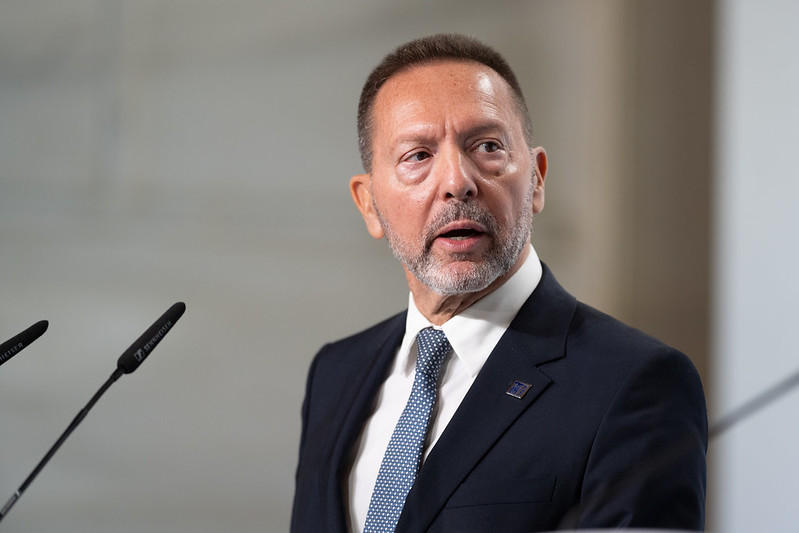
By David Barwick – FRANKFURT (Econostream) – European Central Bank Governing Council member Yannis Stournaras said on Sunday that Europe needed to deepen integration to raise growth, strengthen resilience and close its financing gap with other major economies.
Stournaras, who heads the Bank of Greece, told Italian newspaper Avvenire that Europe was facing weak growth, geopolitical tensions and inflationary pressures stemming in part from energy shocks.
“The ECB remains focused on price stability, with the aim of bringing inflation back to 2% over the medium term,” he said.
Fiscal policy should support vulnerable households and businesses, but avoid broad or long-lasting measures that could add to inflation, Stournaras said.
Asked where the European Union should act more forcefully, Stournaras said: “We need a qualitative leap.”
Completing the Single Market, especially in services and digital technology, was a priority for productivity and potential growth, he said.
Europe also needed to strengthen the banking union and accelerate the creation of a real European capital market able to mobilize private savings for strategic investment, Stournaras said.
“If this is not done, Europe will continue to face a financing gap compared to other major economies,” he said.
Industrial policy also required stronger coordination among member states, Stournaras said, citing energy, advanced technologies, artificial intelligence and defense.
Current fragmentation limited the effectiveness of policy measures and raised costs, he said.
Europe also needed to reduce internal barriers, simplify regulation and make it easier for European companies to grow, Stournaras said.
The energy issue remained central, he said, after recent crises exposed Europe’s vulnerability.
Coordinated investment was needed in infrastructure, interconnections and diversification of energy sources, along with faster deployment of renewables, Stournaras said.
“It is not just an environmental objective, but a question of economic security,” he said.
Common crisis-response tools should also be strengthened, Stournaras said, pointing to the pandemic as evidence that joint European initiatives could have a significant impact.
Looking at the international environment, Stournaras said volatility would remain high.
“The EU should strengthen its resilience by investing in energy security, defense and technology,” he said.
Maintaining internal cohesion, avoiding political fragmentation and strengthening integration would also be crucial, he said.