
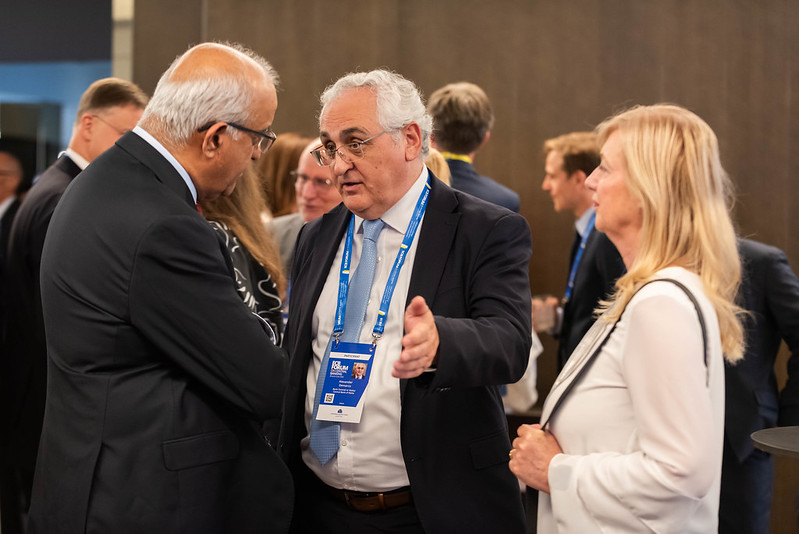
By David Barwick – FRANKFURT (Econostream) – European Central Bank Governing Council member Alexander Demarco said Tuesday that the ECB’s ability to look through the latest oil shock was weakening as the Middle East conflict drags on and energy prices remain elevated.
Demarco, who heads the Central Bank of Malta, told Politico that the ECB still had to proceed meeting by meeting and remain guided by incoming data, but sounded increasingly skeptical that the shock would prove benign enough to leave policy unchanged.
“The prospects of looking through this shock appear to be fading now, given the prolongation of the conflict and the prospects of oil prices remaining higher for longer,” he said.
Even if the war ended before the ECB’s June 11 meeting, energy prices might not fully retrace the increase caused by the conflict, Demarco said.
“The damage done to the infrastructure is likely to keep energy prices at a higher level than that prevailing before the conflict,” he told the news organization.
Safe passage through the Strait of Hormuz could also remain impaired even after a ceasefire, he said.
“Supply constraints are likely to linger,” Demarco said.
The ECB had to prevent higher energy costs from spreading into broader inflation and influencing medium-term expectations, he said. Expectations had not yet broken higher, but it was too soon to draw comfort from that, he said.
“These things don’t happen overnight,” he said.
Demarco declined to specify how many rate increases might ultimately be required.
“We are committed to setting monetary policy to ensure that inflation stabilizes at 2 percent in the medium term,” he said. “This could require one rate hike. It could require more.”
The policy dilemma remained that a rate hike in response to an energy shock could worsen the hit to growth, Demarco acknowledged.
A recession was still not the ECB’s baseline, he indicated, but the risk would rise if the crisis escalated to the point of fuel rationing.
“If we arrive at that point, then there is, of course, a real risk of recession, but at this juncture we are not there,” he said, according to Politico.
Demarco also criticized Europe’s slow progress on reforms to raise long-term growth and deepen capital markets, including common bond issuance.
“Especially on common bonds, I’m not seeing that much progress in this direction,” he said.
“Things move slowly in Europe,” he said, calling for governments to simplify EU decision-making and drop unanimity requirements in some policy areas.