
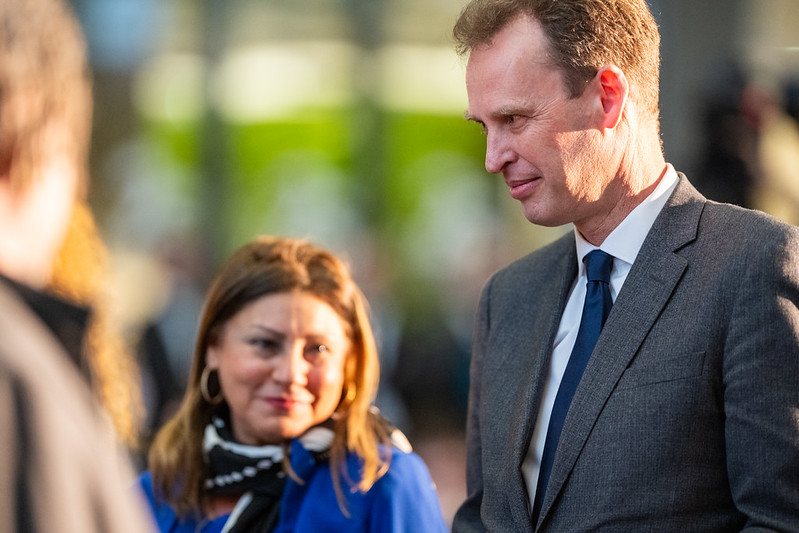
By David Barwick – FRANKFURT (Econostream) – European Central Bank Executive Board member Frank Elderson on Tuesday said Europe’s banking sector was held back by fragmented markets rather than excessive regulation, calling for faster progress on the banking union, capital markets integration and the Single Market.
In a speech in Brussels, Elderson, who is also vice chair of the ECB’s Supervisory Board, said fragmentation weakened monetary policy effectiveness, banking market efficiency and the competitiveness of the European economy.
“[T]he most powerful way to turn the tide across several interconnected fronts is through more Europe,” he said. “And more Europe means: advancing the savings and investments union, deepening the Single Market, and enhancing integration so that we can unleash our full potential.”
Europe still lacked truly integrated banking markets, Elderson said. Around 80% of bank lending went to households and firms in banks’ home countries, fewer than 2% of deposits were held across borders, and cross-border merger activity had fallen sharply compared with before the financial crisis, he said.
“In practice, the European banking market remains largely national rather than truly European,” he said.
Elderson said Europe’s Single Market was “far from single,” particularly in services, with banks facing a patchwork of legal frameworks, consumer protection rules and insolvency regimes.
This fragmentation prevented banks from diversifying risks across countries, achieving economies of scale and deploying capital efficiently at the European level, he said.
A serious competitiveness agenda should therefore start with a time-bound roadmap to complete the Single Market, Elderson said.
He also called for the banking union to be treated as a single jurisdiction, with cross-border banking as seamless as domestic banking and capital and liquidity able to flow freely within cross-border banking groups.
This required concrete steps toward finalizing a European Deposit Insurance Scheme with a clear implementation timetable, as well as a stronger EU framework for liquidity in resolution, he said.
At the same time, Europe should not weaken bank resilience, Elderson said. Sound regulation and effective supervision had made European banks stronger, better capitalized, more liquid and more operationally resilient, he said.
“Resilience has therefore not held Europe back,” he said. “On the contrary, it has been one of the preconditions for sustainable growth, enabling Europe to invest and remain competitive.”
Elderson also said supervisory simplification had a role in Europe’s competitiveness agenda, but this should mean simpler requirements, not lower requirements.
The ECB saw room to simplify the EU’s risk-based capital framework while maintaining resilience, including by merging the five existing macroprudential buffers into two, he said.
“[W]e want simpler requirements, not lower requirements,” he said.
Europe had “no excuse for delay, no justification for paralysis, no reason for inaction,” Elderson said.