
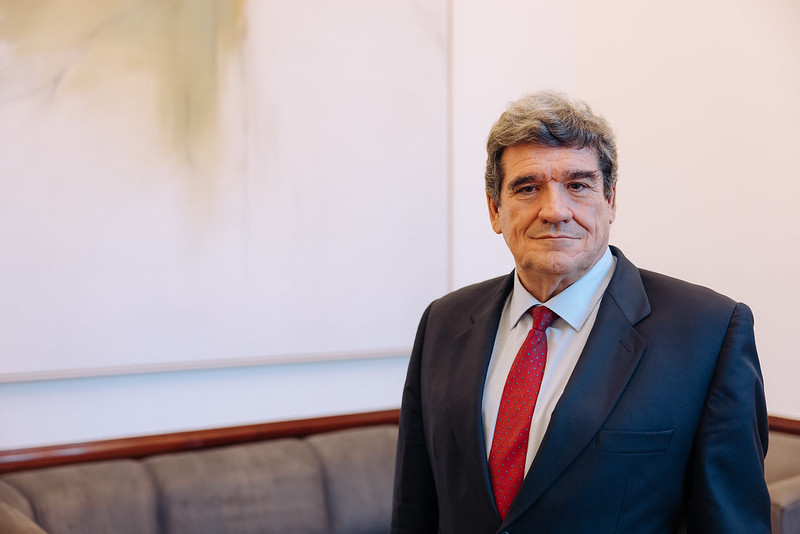
By Marta Vilar – MADRID (Econostream) – European Central Bank Governing Council member José Luis Escrivá on Saturday said private stablecoins could not serve as the anchor of the monetary system, arguing that central banks remained essential guarantors of trust amid geoeconomic fragmentation and rapid technological change.
In closing remarks at the Banco de España LatAm Economic Forum in Roda de Bará, Spain, Escrivá, who heads the Banco de España, said the forum had focused on two major forces reshaping the environment for central banks: changes in the geoeconomic order and technology affecting money, payments and finance.
“In a world being reshaped by geoeconomic fragmentation and by technological change, central banks provide one of the most valuable public goods in times of uncertainty: trust,” he said.
The impact of geopolitical shocks and trends depended crucially on the credibility of monetary policy, Escrivá said. When the framework was credible, exchange rate adjustment was more limited and orderly, inflation pass-through was contained and spillovers to financing conditions were easier to manage, he said.
Central banks also needed to incorporate new technologies, but those technologies in turn needed to rely on central banks as ultimate guarantors, Escrivá said.
“Private stablecoins, by their nature, cannot anchor the monetary system: their stability rests on contingent confidence in their backing, and that confidence can vanish at the very moment it is most needed,” he said.
“What central banks provide — and what no private instrument can substitute — is the ultimate anchor of trust on which financial systems rest,” he said.
Escrivá said ECB President Christine Lagarde’s keynote speech on Friday had shown that innovation was compatible with preserving monetary and settlement functions within the central bank domain, particularly the role of central bank money as the basic anchor of the payment system.
Geoeconomic measures were often designed from a static perspective, as if the structure of the global economy could be taken as given, Escrivá said. In reality, economies, governments, firms and households adapted, he said.
“The broader lesson is that the response to geoeconomic pressure is endogenous and dynamic,” he said. “The longer-term effects of these measures may differ substantially from their immediate effects — and, in some cases, may even run counter to the objectives of those who designed them.”
Tariffs mattered less through direct trade effects than through the financial channels they activated, Escrivá said.
Tariffs first affected financial markets by changing the value of existing assets and liabilities and prompting investors to move or withdraw capital, he said. That could have large effects on exchange rates, asset prices and financial stability, putting capital flows at the center of geoeconomic transmission, he said.
Geoeconomic pressure depended critically on choke points rather than tariffs as such, Escrivá said. Its effectiveness scaled with control over critical nodes and the difficulty of substituting them, he said.
“Where control is high and substitutability is low, interdependence becomes vulnerability, turning globalization from a stabilizing force into a channel for coercion,” he said.
The relevant choke points were in finance, technology, platforms and critical inputs, Escrivá said.
Turning to Latin America, Escrivá said the region had become more resilient than in the past.
Monetary policy frameworks in Latin America had strengthened significantly over time, central banks had gained credibility, inflation targeting had matured and flexible exchange rates had continued to work as shock absorbers, even in a global environment still dominated by the dollar, he said.
“This greater credibility has allowed central banks to navigate recent global shocks with fewer episodes of de-anchoring of expectations and more systematic policy responses,” he said. “Monetary policy in the region is working better than in the past.”
However, resilience should not lead to complacency, Escrivá said. Monetary policy could not be expected to do all the heavy lifting by itself, particularly in an environment increasingly shaped by supply shocks, he said.
Latin America’s growth remained modest and uneven despite its recent resilience, the result of structural constraints and weak productivity rather than just cyclical factors, Escrivá said.
Changes in global capital flows compounded those challenges, he said. Such flows were increasingly driven by non-bank financial intermediaries and potentially by faster and more opaque digital channels, making them more price-sensitive and more prone to sudden reversals, he said.
As a result, greater weight fell on fiscal policy, structural reforms and robust macro-financial and prudential frameworks, Escrivá said.
“The region has gained trust in an essential pillar of prosperity, macroeconomic stability,” he said. “But while macroeconomic stability is a necessary condition, it has become increasingly clear that it is not sufficient.”
Latin America’s future performance would depend increasingly on moving up the technology ladder, diversification and the ability to attract and retain high-quality, long-term capital, Escrivá said.