
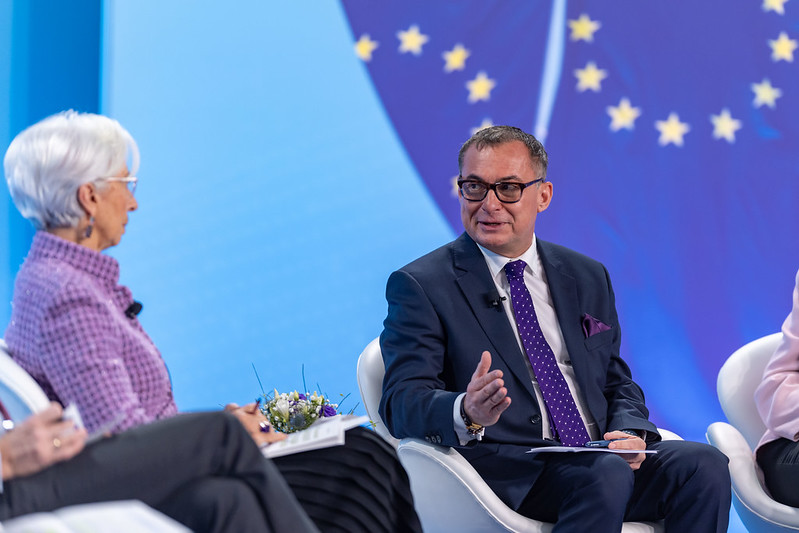
By Marta Vilar – MADRID (Econostream) – European Central Bank Governing Council member Joachim Nagel said on Friday that the Eurosystem remained highly vigilant about inflationary risks stemming from the energy shock, while arguing that Germany faced major structural challenges requiring reforms to labor supply, investment conditions and productivity growth.
In a speech at the 79th Monetary Workshop in Darmstadt, Germany, Nagel said the medium-term inflationary impact of the Iran war remained difficult to assess, justifying the Governing Council’s decision to leave interest rates unchanged at its April meeting.
“The Governing Council is aware of the increasing risks to price stability and is very vigilant,” he said. “We will do what is necessary to prevent the energy-driven price increase from spreading and becoming entrenched.”
Nagel, who heads the Deutsche Bundesbank, said the German economy’s weak growth performance in recent years reflected a loss of competitiveness among German firms, weaker demand for key export products and rising competitive pressure from China.
“The German growth engine began to sputter as early as the late 2010s,” he said, pointing to declining export market shares and weak potential growth.
According to Nagel, German potential growth is expected to average only around 0.4% annually in the coming years, down from more than 1% before the pandemic.
Labor shortages caused by demographic change were one of the country’s key structural problems, Nagel said. While immigration and higher labor force participation had helped offset the shrinking working-age population in recent years, these factors would no longer be sufficient in the future, he said.
“Germany should do everything in its power to increase the labor supply,” he said, calling for measures including better childcare availability, more labor-market-oriented immigration and incentives for older workers to remain in employment longer.
Germany also urgently needed to reduce bureaucracy in order to revive private investment, Nagel said, saying excessive regulation had become a major obstacle for companies.
“Germany is therefore drawing on its capital stock,” he said, noting that net capital investment in 2024 and 2025 had turned negative for the first time since reunification.
Nagel said Germany lagged behind in high-tech investment and innovation, despite strength in medium-technology industries such as the automotive sector.
He nevertheless pointed to some encouraging developments, including a rise in startup activity and broader adoption of artificial intelligence among German firms.
According to a recent Bundesbank survey cited by Nagel, the share of companies using or planning to use generative AI is expected to rise from 26% in 2024 to 56% in 2026.
Most companies adopting generative AI expect noticeable productivity gains, he said.