
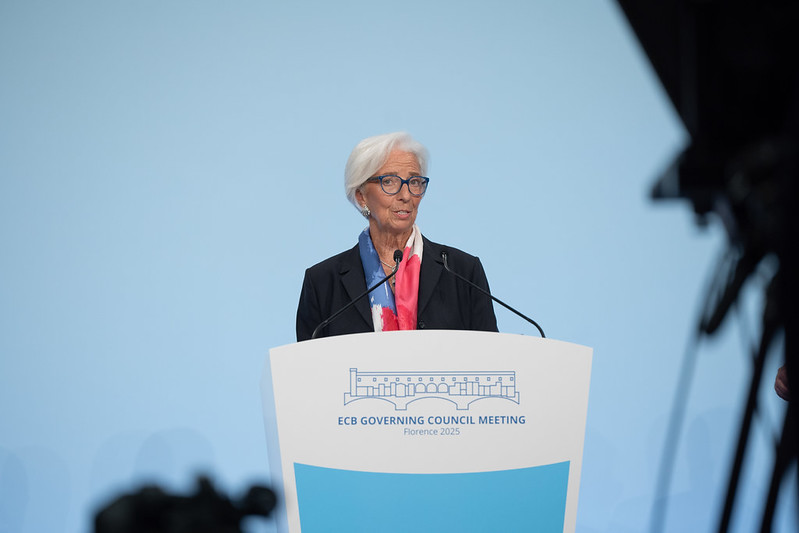
By David Barwick – FRANKFURT (Econostream) – European Central Bank President Christine Lagarde on Friday said Europe should not respond to the spread of dollar stablecoins by simply promoting euro-denominated versions, warning that this could create financial stability risks and weaken monetary policy transmission.
In a speech at the Banco de España LatAm Economic Forum in Roda de Bará, Spain, Lagarde said stablecoins had grown from less than $10 billion six years ago to more than $300 billion today, with almost 98% denominated in dollars and nearly 90% of the market controlled by Tether and Circle.
The policy debate had shifted in the United States, where the GENIUS Act was described by the US administration as a way to ensure “the continued global dominance of the U.S. dollar” and support demand for US Treasuries, she said.
Europe should not frame the issue as a need to match the US model, Lagarde said. The debate had failed to distinguish clearly enough between stablecoins’ monetary function and their technological function, she said.
“[O]nce we disentangle those two functions, the case for promoting euro-denominated stablecoins is far weaker than it appears,” she said.
Euro-denominated stablecoins could in theory increase global demand for Eurozone safe assets, compress sovereign yields, ease financing conditions and extend the euro’s international reach, Lagarde said.
But the trade-offs would be material, she said, citing financial stability risks and the risk of impaired monetary policy transmission.
Stablecoins are private liabilities whose stability depends on the credibility and liquidity of their backing, Lagarde said. In times of stress, redemption demand could become “sudden and self-reinforcing,” with potential feedback loops into underlying asset markets, she said.
This was not hypothetical, she said, recalling that USD Coin briefly traded well below parity after Circle disclosed in March 2023 that $3.3 billion of its reserves were held at Silicon Valley Bank.
Multi-issuer schemes could add further risk, Lagarde said. Where stablecoins were issued jointly by EU and non-EU entities, MiCAR safeguards would apply only to the EU issuer, while investors in a run would likely seek redemption where protections were strongest.
“We know the dangers,” she said. “And we do not need to wait for a crisis to prevent them.”
Lagarde also warned that large-scale substitution of bank deposits with stablecoins could weaken the ECB’s ability to transmit policy rates to firms and households.
“When retail deposits migrate into non-bank stablecoins and return to banks as wholesale funding, that channel narrows,” she said. “Banks lend less, or less efficiently, and the pass-through from policy rates to the real economy weakens.”
In the Eurozone, where banks remain the dominant source of credit to the real economy, large-scale deposit substitution would weaken lending to firms and monetary policy transmission, she said.
The short-term gains from euro-denominated stablecoins would therefore not justify the risks, Lagarde said.
“If we want to strengthen the international appeal of the euro, stablecoins are not an efficient way of doing so,” she said. “The best solution remains the same: more integrated capital markets through the savings and investments union, and over time a safe asset base that matches the scale of our ambitions for the euro's international role.”
The technological function of stablecoins was different, Lagarde said, calling distributed ledger technology “genuinely transformative” for financial market infrastructure.
The risk of rapid dollar stablecoin uptake in European tokenized markets was legitimate, she said, because it could entrench dollar dependency at the settlement-infrastructure level.
But the answer was not to reject the technology or discourage stablecoins altogether, she said. Instead, Europe needed public infrastructure allowing stablecoins, tokenized deposits and other forms of tokenized money to operate in a framework anchored by central bank money.
Stablecoins themselves had structural weaknesses as a settlement foundation, Lagarde said. They could break from their peg in stress and fragment markets across competing instruments, she said.
“As stablecoins can break away from their peg during times of stress, they do not confer the unconditional finality that central bank money does,” she said.
The Eurosystem was therefore building infrastructure for wholesale settlement in central bank money, Lagarde said. From September, its Pontes project would link distributed ledger platforms to TARGET, allowing DLT-based transactions to be settled in central bank money, she said.
Tests conducted in 2024 showed that the model worked in real-world conditions, with 50 transactions across nine jurisdictions and about €1.6 billion in settled value, she said.
The Appia roadmap published in March went further, setting out a path to a fully interoperable European tokenized financial ecosystem by 2028, Lagarde said.
“When central bank money is available natively on-chain, and when tokenized deposits and MiCAR-compliant euro instruments can operate within the same interoperable environment, market participants will have no reason to rely on a foreign private substitute by default,” she said.
Europe’s task was therefore not to reproduce the stablecoin model developed elsewhere, but to build the foundations needed for its own financial system, Lagarde said.
“Our task is not to replicate instruments developed elsewhere, but to build the foundations and the infrastructure that serve our own objectives, so that we can harness the benefits of innovation without importing the fragilities,” she said.