
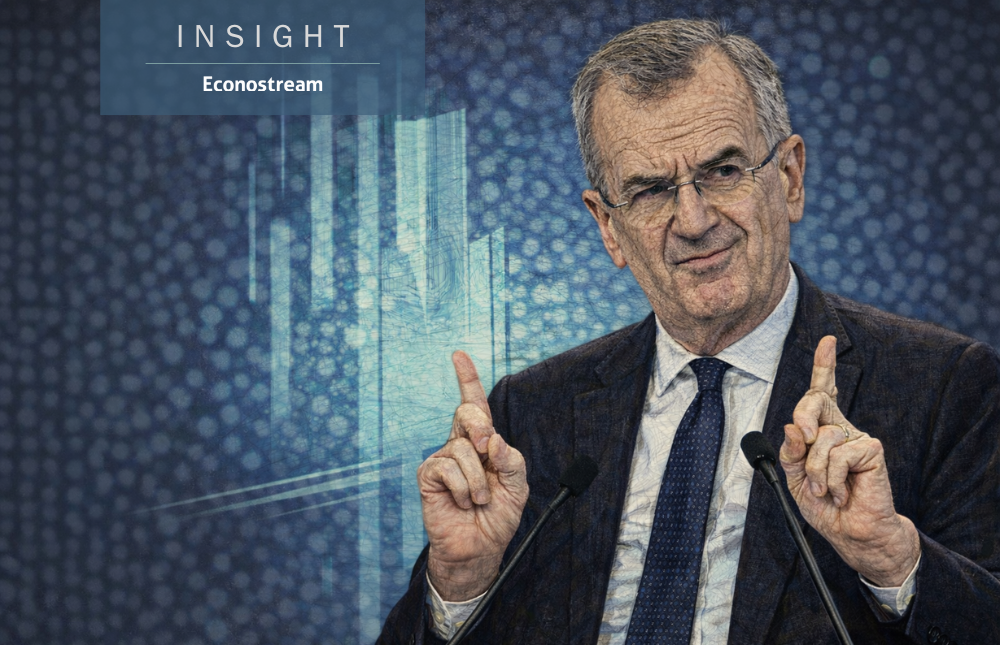
By David Barwick – FRANKFURT (Econostream) – European Central Bank Governing Council member François Villeroy de Galhau’s final monetary policy speech as Banque de France governor on Thursday was meant to be an exercise in humility. Hypocrisy won.

Delivered, as usual, in the manner of a somewhat pedantic professor lecturing the uninitiated, Villeroy’s speech mixed self-congratulation over ECB successes—never mind that these were achieved via policies often at odds with his preference for easier money—with a plea for central bankers to show greater humility.

The most galling aspect of the intervention, however, was Villeroy’s chastisement of colleagues for signaling, despite a long record of doing the same himself.

“Since last Thursday’s meeting of our Governing Council, I have read a great deal of speculation and several statements about the timing of our next interest rate hike at the ECB; this strikes me as looking a bit too much like disguised forward guidance,” huffed Villeroy, the self-styled arbiter of ECB communication rules.

One can argue about where the sometimes-fine line lies; ECB President Christine Lagarde herself at least flirted with it last week when she said that “directionally, I know where we’re heading” and then made clear what direction she had in mind.

It is not the first time Villeroy has taken aim at colleagues’ signaling over the timing of hikes; if he ever complained about others flagging cuts, we’re unaware of it. That Villeroy has the temerity to take this swipe at his soon-to-be-former colleagues is the apex of hypocrisy, given that few if any of his peers have put more effort than he into shaping market expectations while pretending merely to explain policy. The main difference is that his “steers” almost always reflect his personal inclination.

His recent record is not hard to assemble:

• On January 12, he dismissed 2026 rate hike expectations, “barring an unlikely shock,” as “a fanciful theory.”

• On April 2, he said it was too early to call the timing, but that the next rate move was “highly likely” to be upward.

• On April 16, he called bets on an April hike “premature” and said the ECB was “not in precipitation mode.”

Explicitly hinting at a timetable for rate hikes is one form of signaling. Steering markets toward a preferred interpretation of the likely timing and conditions of future policy moves is another.

Villeroy’s real objection appears not to be to signaling per se, but to signaling done by others without the veneer of contrived erudition. His own signaling is helpful clarification; others’ is a communications violation.

The result was a farewell speech that preached humility while displaying precisely the sort of intellectual self-exemption for which policymakers are justly criticized.