
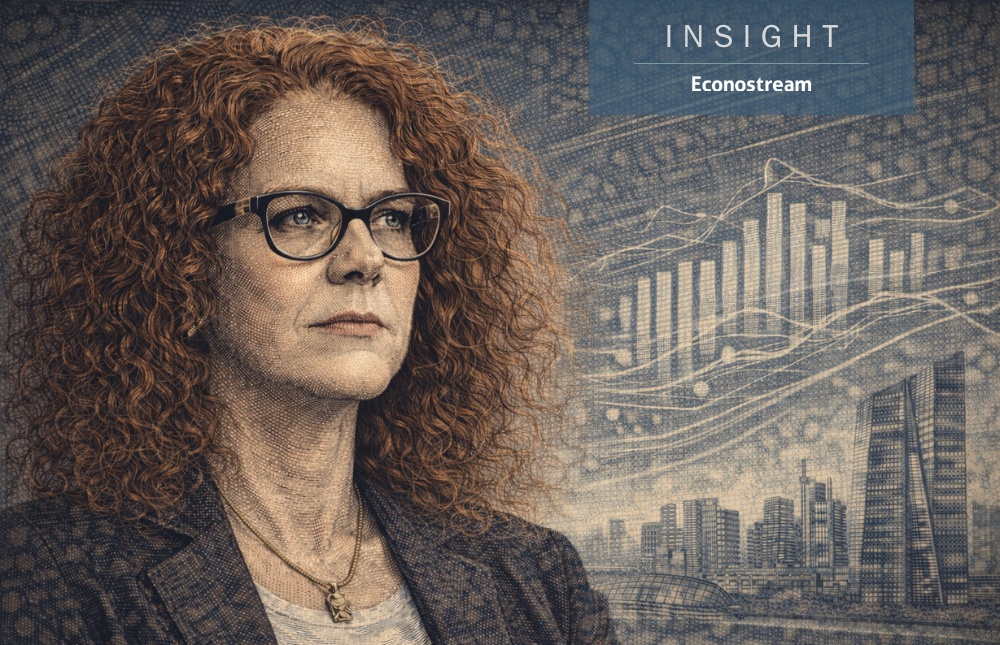
By David Barwick – FRANKFURT (Econostream) – Although her remarks on Thursday evening may have been taken hawkishly, European Central Bank Executive Board member Isabel Schnabel did not make the case that the ECB must raise rates in June, even if such an outcome seems likely from today’s perspective. Rather, while continuing to leave the ECB an escape hatch, she emphasized that waiting for wage growth to prove second-round effects could imply waiting too long.
That is the key shift in Schnabel’s latest communication. In late March, her message was that the ECB had time to assess whether the inflationary consequences of the Middle East shock would broaden into more persistent price pressures. Six weeks further into the shock, the emphasis has moved toward the danger of reacting too slowly if that broadening is already beginning.
In terms of the framework, there is no obvious fundamental change: on March 27, she argued that there was “no need to rush into action,” even as she acknowledged that inflation risks had tilted upward and that second-round effects were the critical issue. Taking a stand to which the entire Council eventually came around, Schnabel realized earlier than most that the ECB had time to observe whether firms, households and wage-setters would begin transmitting the shock more broadly through the economy.
That conditional structure was still evident in her speech yesterday at the London School of Economics, where she again focused on the risk that the energy shock could broaden through expectations and pricing behavior, warning that shocks may pass through faster than they did in 2021 because the previous inflation episode remains fresh in economic agents’ minds.
“If the energy price shock broadens, monetary policy will need to tighten,” she said.
This is not to say that tightening is inevitable, and she steered well clear of tying anyone to a particular Governing Council meeting. Her condition, broadening inflationary dynamics and emerging second-round effects, remained the same.
The Q&A that followed nonetheless made clear that her reaction function has grown more preemptive.
Asked whether the ECB should wait for wage growth to rise before tightening, Schnabel warned that “if we wait for that to materialize, we will in any case be too late.” Wages, in other words, are a lagging indicator.
And yet, there was no suggestion of a desire to react to higher energy prices mechanically. Reminiscent of her March intervention, Schnabel explicitly left open the possibility that even now, no policy response may be needed if weak demand or recession limits firms’ ability to shift higher costs onto consumers.
“If the economy already entered the recession, the pricing power of the firms will be relatively limited and the ability to pass through the high cost to the prices will be limited,” she said. “And that could mean that the policy response is not needed.”
The result is a position that is clearly hawkish, but not crudely so. Schnabel is not arguing for calendar-based tightening, merely against waiting for the clearest and latest evidence before acting if the underlying inflation process already appears to be broadening.
Her message is therefore not “June or bust,” but rather: do not wait too long.


