
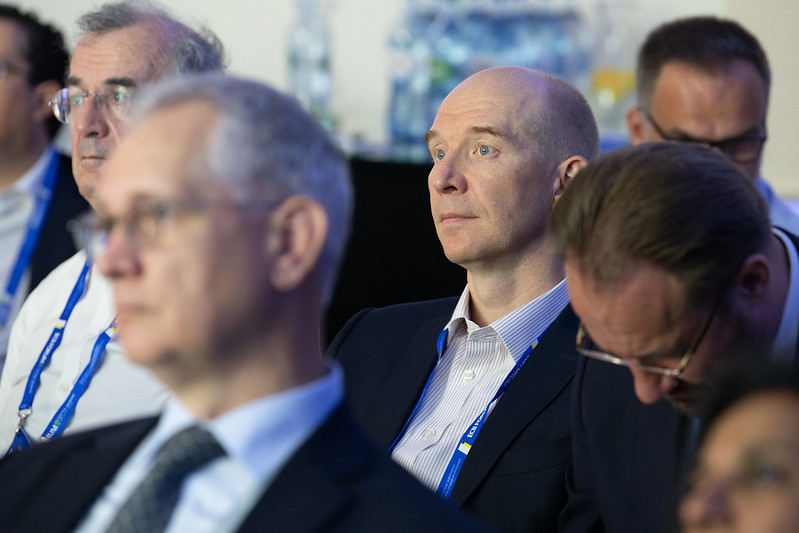
By David Barwick – FRANKFURT (Econostream) – European Central Bank Governing Council member Madis Müller said the ECB had not yet needed to raise interest rates this week, but that it was increasingly likely it would have to do so later.
Müller, who heads Eesti Pank, said in a blog post on his central bank's website that the economic impact of the Iran war and the associated energy price shock remained difficult to assess.
“A quick solution to the Middle East conflict is not in sight, and it is becoming increasingly clear that we will have to accept higher energy prices for a longer period,” he said.
The first signs were already visible that higher energy prices were passing through to other goods and services, initially in sectors where energy was an important input, including air fares, chemicals and plastics, Müller said.
Business surveys pointed to cost pressure, but there was still no direct evidence that more expensive energy was exerting broader pressure on various prices, he said.
At the same time, surveys showed that companies and consumers expected inflation to accelerate in the coming years, which was understandable against the background of higher fuel prices, he said.
Financial markets did not doubt the central bank’s ability to keep inflation close to 2% over the longer run, according to Müller.
Nor was there any doubt within the Governing Council that it stood ready to make the decisions needed to achieve that objective, he said.
A key issue in deciding whether to raise interest rates would be the energy shock’s impact on economic growth, Müller said.
It was clear that Eurozone growth would be weaker in the near term than previously expected because of the Iran war, with business expectations for order growth having deteriorated and consumer confidence having worsened sharply, he said.
“[I]n deciding on interest rates, the central bank must assess the balance between two opposing forces,” he said. “On the one hand, more expensive energy accelerates overall price growth; on the other hand, a broader slowdown in the economy brings slower inflation.”
The Governing Council had been able to leave interest rates unchanged this week in part because longer-term market rates had already risen following the outbreak of the Iran war, Müller said.
This meant that the tightening of financing conditions needed to counter inflation pressures had already happened without direct central bank intervention, he said.
However, that advance effect would lose strength if central bank interest rates remained unchanged for a longer period, Müller said.
“For this reason, it is worth being prepared that in the near future the European Central Bank Governing Council may nevertheless be forced to raise interest rates,” he said.
Only a couple of months ago, he had thought it possible to say after the latest ECB monetary policy meeting that Eurozone inflation had finally stabilized close to the 2% target after turbulent years for central bankers, Müller said.
“After the outbreak of the Iran war and the sharp rise in energy prices, unfortunately I can no longer say that,” he said.
Still, he had no doubt that the ECB was ready to react and would continue to do everything necessary to preserve the euro’s purchasing power, Müller said.