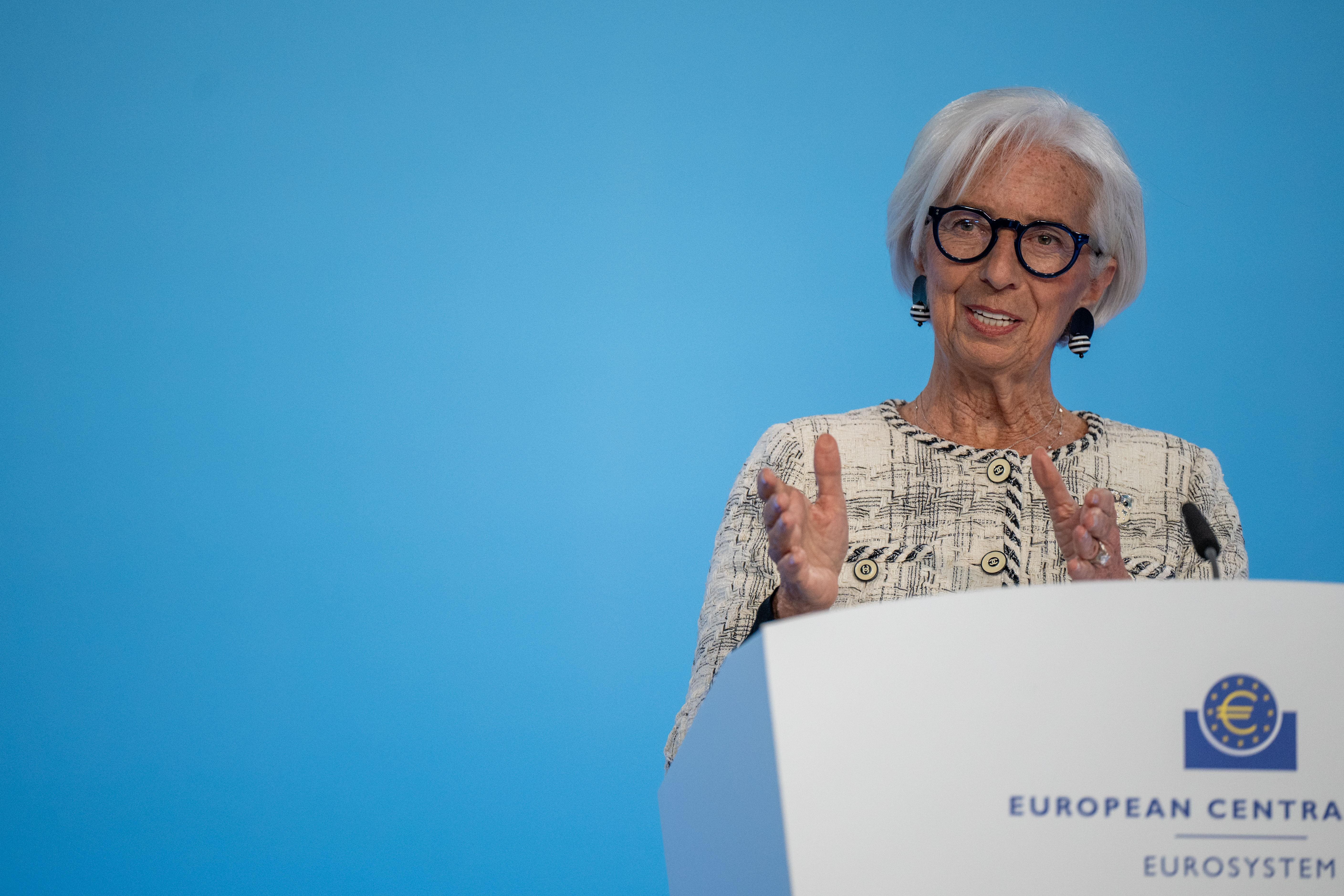
By Marta Vilar – FRANKFURT (Econostream) – European Central Bank President Christine Lagarde said on Thursday that Governing Council members had discussed a possible interest rate hike at the latest meeting, characterizing the general direction of policy as evident and declaring June the right moment to reassess conditions.
Speaking at the press conference following the meeting, Lagarde declined to specify where the current outlook sat between the baseline and more adverse scenarios, but stressed that it was “certain” that the situation was moving away from the baseline.
“If I was to summarize for you what we decided today, I would say we made an informed decision on the basis of yet-insufficient information,” she said, adding that the Governing Council had “debated at length and in depth various options.”
“We debated the decision that we have unanimously taken today, but we also debated at length and in depth the decision to possibly hike,” she said. “So, that was debated amongst all governors.”
She said that incoming hard data had broadly aligned with the ECB’s March projections, but uncertainty remained exceptionally high, requiring a fresh assessment at the next policy meeting.
Given the ECB’s good starting position, she said that “six weeks will be the right time to assess the development, to understand in particular the outcome, possibly, of the conflict. Or if there is no outcome, that in and of itself will be informative in order to make an informed decision on verified and revisited information that we will receive in the next six [weeks].”
The June meeting would include new staff projections and revised scenario analysis related to the Middle East conflict, she said.
Responding to questions about her wording, Lagarde denied intending to signal policy shifts through subtle language changes, though she acknowledged that the removal of the word “tilted” from the ECB statement reflected updated data and a worsening risk assessment.
“[W]e are bound to revisit the situation on the basis of the data, the projections, the sensitivity analysis, the updated scenarios and then we will take a decision,” she said. “I think directionally I know where we're heading.”
However, nothing was etched in stone, she said, as “[t]here might be massive changes taking place,” although even if the conflict ended immediately, supply shocks and their effects would still persist.
“There will be [effects from negative supply shocks], we know that,” she added. “Because of the infrastructure, because of the logistics, because of the time lag and all that.”
Asked about stagflation, Lagarde declined to characterize the current environment as stagnation, adding that this was not a scenario the ECB currently considered likely.
On inflation dynamics, she said the ECB was not seeing second-round effects but was observing some indirect pressures.
“There is no intention on the part of the corporate leaders to significantly increase wages, there is a labor market that is more fluid than it was,” she said. “Financial tightening is happening, so for all those reasons we want to give ourselves the time the depth and the necessary analysis to determine in June what is necessary in order to reach our 2% target.”