
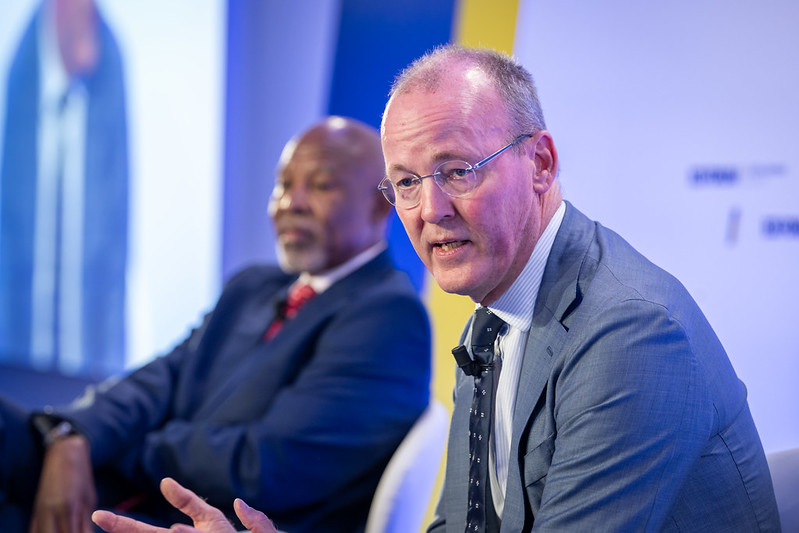
By David Barwick – BUDAPEST (Econostream) – Former European Central Bank Governing Council member Klaas Knot on Monday said economic fragmentation required monetary authorities to monitor inflation expectations closely, while avoiding unnecessary damage from excessive policy action.
Speaking on a panel at the Lámfalussy Lectures Conference in Budapest, Knot said the global economy had moved from a relatively smooth process of globalization into a more disruptive period of fragmentation.
“We are living in a world of deglobalization,” he said. Deglobalization, unlike globalization, was “a much more shockwise, abrupt process.”
The result was that policymakers were being forced to deal with fragmentation, he said. A useful guide for policy was to “do what is necessary, but as little as possible,” Knot said.
Monetary authorities should “be very careful in watching inflation expectations,” a reality there was “no escaping,” he said. At the same time, policymakers should do as little as possible, “because you don’t want to create any undue harm,” he said.
Knot pointed to the ECB’s 2011 rate hikes as a warning against overreacting.
“In Europe there is also the memory of 2011, that you can also do too much too quick,” he said. “What happened there is that there was a sort of financial crisis brewing under the surface.”
At present, equity markets showed high valuations, he noted. “That could be the trigger of financial turmoil,” he said. “Am I predicting the next financial crisis? No, I am not.” The point was rather that one “must always be alert,” he said.
Banks remained central to whether financial risks became systemic, but the sector was far stronger than before the global financial crisis, he said.
“I would dare to posit that the banking sector is in much, much better shape today than it was 15, 20 years ago,” he said.
Central bank independence remained a “lingering” issue, he said, though less lately because of “frontal attacks” than because of fiscal pressure.
In the US, with Kevin Warsh, “a fairly mainstream central banker has now been named as the new chair” of the Federal Reserve, Knot observed.
“But there is the most subtle form of undermining central bank independence, and that of course is fiscal dominance,” he cautioned.