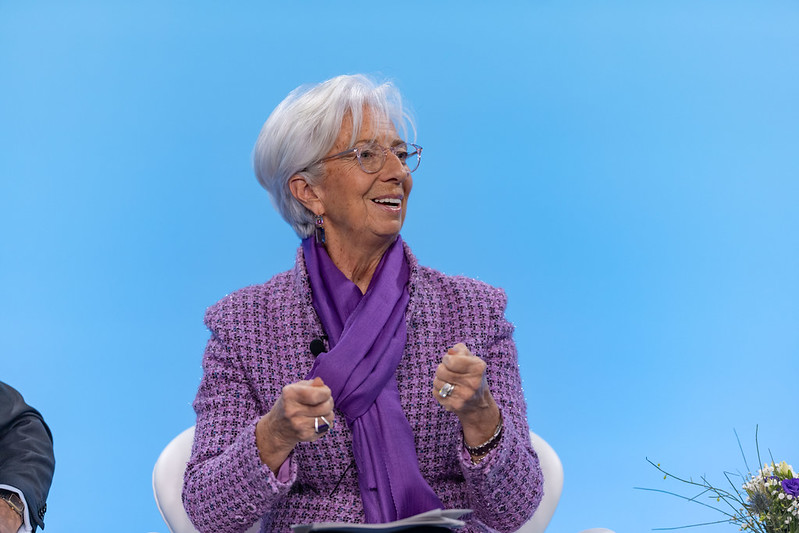
By David Barwick – WASHINGTON (Econostream) – European Central Bank Executive Board member Isabel Schnabel said Wednesday that the ECB could afford to take time assessing the inflation implications of the Middle East war, arguing that policymakers were starting from a relatively favorable position even as they watched closely for stronger pass-through and second-round effects.
Speaking on an Institute of International Finance panel, Schnabel said the current shock was especially difficult to read because it had come after “a very long period of above-target inflation in many countries,” meaning “the memory of high inflation is still very fresh” and inflation expectations could therefore be “more fragile.”
“What really matters is the pass-through to consumer prices,” she said. Referring to the post-pandemic inflation surge, she said that “back then, we had underestimated the pass-through,” adding that “this is why now everybody is very much focusing on the strength of the pass-through.”
In her telling, that pass-through could prove stronger this time because “the firms have learned that it’s actually quite easy to change prices more frequently,” while “the workers may have learned that they shouldn’t be too patient, because last time they actually had to wait for a long time until they recovered their purchasing power.”
At the same time, she stressed that the extent of pass-through would depend heavily on demand conditions. “Especially for a country that is a net energy importer, of course this shock weakens the economy, and this may make it harder for firms to pass through the higher costs to prices, and it may be harder for the workers to actually negotiate higher wages,” she said.
That meant, she said, that “we have to weigh our policy decisions very carefully,” remain “data-dependent” and judge “which of the forces prevail.” Officials would therefore need to watch inflation expectations, wage- and price-setting behavior and the effect of the shock on aggregate demand, she said.
“And of course … we do not want to impose any unnecessary costs on the economy, so that has to also to be part of our thinking,” she said.
Schnabel argued that the ECB’s starting point gave it room to wait. “We were successful in bringing back inflation to 2% before the war started,” she said. “We have a monetary policy that is broadly neutral,” she added, “and this means we can afford to take the time that is needed in order to analyze the character of this shock, and we do not need to rush into action.”
On financial stability, Schnabel said, “In the euro area, I don’t see acute financial stability risks.” Banks were well capitalized, had liquidity and had shown resilience through the shocks of recent years´, she observed.
Beyond that, she pointed to broader vulnerabilities around private credit and the nonbank financial sector, possible overvaluation in some assets linked to artificial intelligence, unsustainable fiscal trajectories in some countries, questions surrounding the long-run role of the dollar and the risk that geopolitical fragmentation could weaken multilateral cooperation on financial regulation. She also indicated that unfinished regulatory work on nonbanks and the additional challenge posed by stablecoins made continued cross-border cooperation critical for global financial stability.
Turning to the policy mix, Schnabel said central banks took fiscal policy as given and could help anchor inflation expectations and contain second-round effects, but she also underlined that monetary policy worked by damping demand and could not solve supply-side shocks. What was needed in the end, she said, was structural policy aimed at reducing vulnerability to such shocks, including through more diversified supply chains and lower dependence on fossil fuels.