
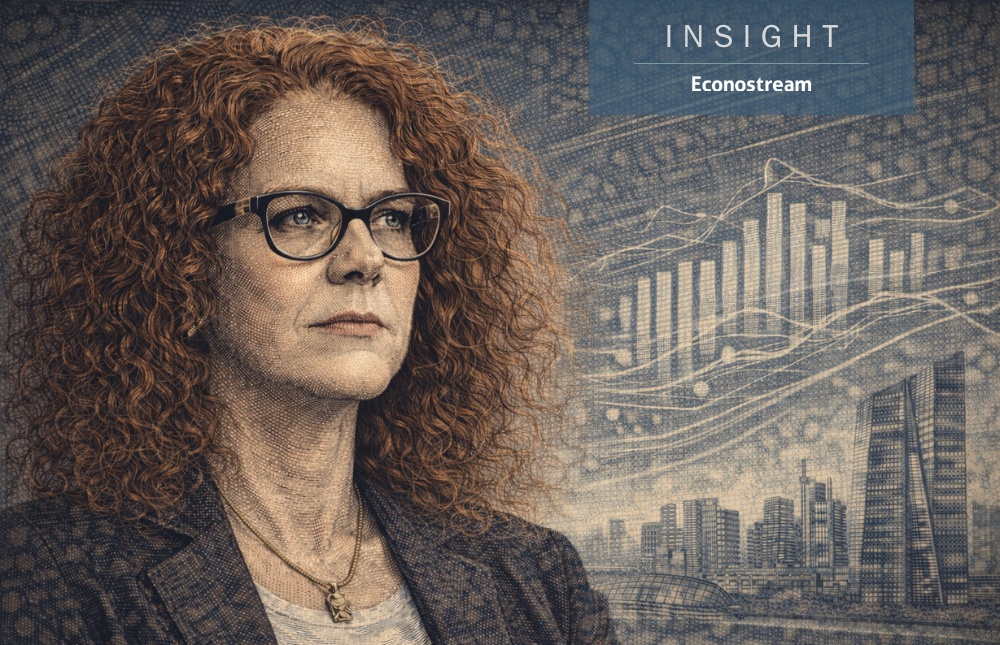
By David Barwick – FRANKFURT (Econostream) – European Central Bank Executive Board member Isabel Schnabel on Friday evening made a clear case for patience without remotely taking tightening off the table. Her core message was that the ECB should not let the memory of 2022 stampede it into treating every supply-side shock as the inevitable start of another inflation spiral, especially when the starting conditions—think today—are materially different.
That was the point of her emphasis on the current policy mix and macro backdrop. Monetary policy is “broadly neutral,” fiscal policy is “broadly neutral,” and the euro area does not face the same post-pandemic demand-supply imbalances that defined the earlier episode.
This was the analytical foundation for a wait-and-see stance: if the starting position is different, then the presumption of immediate monetary reaction need not be the same either.
By no means did she deny that the Iran conflict could yet have longer-lasting consequences. On the contrary, she explicitly acknowledged the possibility of a more persistent regional destabilization and of longer-term effects on inflation.
But that does not mean that she jumped from this possibility straight to policy action. Her argument was that the ECB now knows much better what to watch for and has time to analyze carefully whether the shock is remaining a relative-price disturbance or beginning to embed itself more broadly.
Her remarks fit with her earlier willingness to look through this year’s expected inflation undershooting when she judged that to be the correct analytical response. Her latest comments simply confirm the symmetry of that approach.
In other words, what is good for the goose is good for the gander: the ECB should not stop looking through a shock simply because it is on the upside rather than the downside. It should stop looking through it only once there is reason to conclude that looking through it is no longer justified.
This also echoed the posture she adopted in her speech in New York earlier this month. Then, too, she showed little interest in using Iran as a convenient rhetorical prop for hawkishness.
The line now is much the same: do not overreact, do not mechanically transpose the lessons of the pandemic onto a different environment, but do not miss the signs if pass-through begins to happen more quickly than old models might once have suggested.
The practical effect of remarks like today’s is to make it harder for the hawks to sound too hawkish too soon, because one of the Governing Council’s most credible inflation hawks is herself arguing against haste.
At the same time, they will strengthen the hand of those who want to go slow, because Schnabel has now given them a rigorous intellectual framework for doing so that cannot easily be dismissed as complacency.
None of this settles anything about April. The meeting is still more than a month away, and events in the Middle East, energy markets, inflation expectations, wages, and core prices could still shift materially before then.
But as of today, Schnabel’s intervention clearly does not lend itself to being interpreted as preparation for an imminent move. It is an effort to preserve calm, defend optionality, and insist that the ECB react to entrenched inflation if it materializes, not to the mere possibility of it.


