
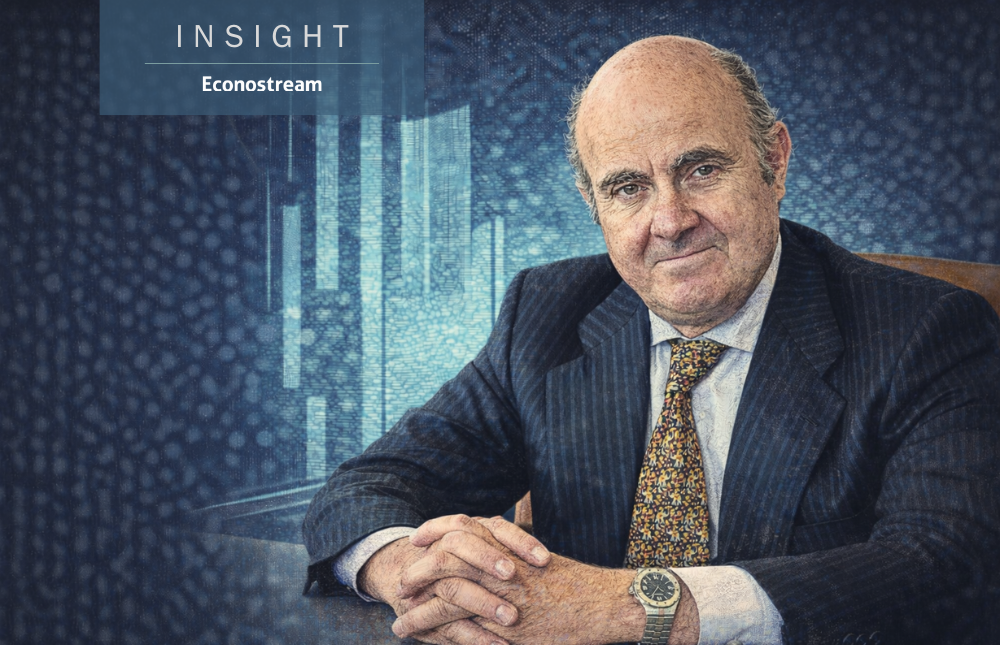
By David Barwick – FRANKFURT (Econostream) – European Central Bank Vice President Luis de Guindos’ interview with Spanish daily El Mundo on Monday was no overt attempt to prepare markets for an April rate hike, given how closely he hewed to the meeting-by-meeting, data-dependent line. And yet, the interview does nothing to make such a decision look less conceivable.

While mainly extending rather than revising Thursday’s message, de Guindos all the same makes it clearer than ECB President Christine Lagarde did that April is live. He does so by saying that “at the next Governing Council meeting in April, we will have more data on the conflict, which is the main source of uncertainty, and we will decide from there.”

That is, without the slightest pre-commitment one way or the other, without even validating a hike bias, de Guindos leaves no doubt that the Council does not see itself as waiting passively for June or some other more comfortable moment. The decision point is the next meeting; the conflict, the central variable.

He also quickly disposes of what could have been a convenient dovish argument by flatly discarding the possibility of recession. He goes further yet, saying that “even in the most severe scenarios, we are still seeing positive growth.” Of course, the March staff projections bear that out, but de Guindos’ willingness to exclude recession nonetheless makes it harder to think that growth weakness by itself could be enough to keep tightening out of the question.

A third point is that his real concern is not the first-round energy shock as such, but whether it spreads. That comes through most clearly in two places. First, he says the ECB will look not only at headline and underlying inflation but also at inflation expectations and at developments in energy, fertilizer and food prices. Second, he says the ECB must be alert to “potential second-round effects,” and then goes further: if governments and other economic actors fail to treat the shock as transitory, “that would obviously force central banks to act.”

That may be the most consequential part of the interview, as it says what kind of April debate de Guindos has in mind: not a mere confirmation of undeniably higher oil and gas prices, but consideration of whether the shock begins to look persistent enough, and broad enough, to contaminate wages, pricing behavior, expectations and core inflation. In other words, de Guindos pushes the reaction function more firmly into the territory of second-round effects.

Here it is worth recalling that the ECB’s alternative scenarios assume unchanged monetary and fiscal policy relative to the baseline, while incorporating stronger indirect and second-round effects on inflation than in the baseline. The adverse case assumes acute energy disruptions through the third quarter of 2026; the severe case pushes that through the fourth quarter, with normalization only from the first quarter of 2027. In that sense, the published scenarios already embody the kind of persistence question de Guindos is now emphasizing verbally.

This is also why we would not describe the interview as simply hawkish. The tone is conditional rather than directional. Asked directly whether hikes are now more likely than cuts, de Guindos naturally declines to confirm, answering instead: “We are ready to respond as necessary.”

That is simply a refusal to close options, not a coded call for action. Still, in the current policy environment, keeping all options open is not as neutral as it would have been a month ago.

Before the Middle East shock, optionality may still have contained meaningful room for further easing. Now, when de Guindos says the conflict will hit inflation hard, that even the severe case does not produce recession, and that second-round effects would compel a response, the practical range of options looks less like hold-or-cut than hold-or-hike, unless the shock fades surprisingly quickly and cleanly.

In the current setting, the difference between “we are not pre-committing” and “we are still deciding in April” is the difference between a placeholder meeting and a live one. De Guindos, without ever quite saying so, has made clear it is the latter.