
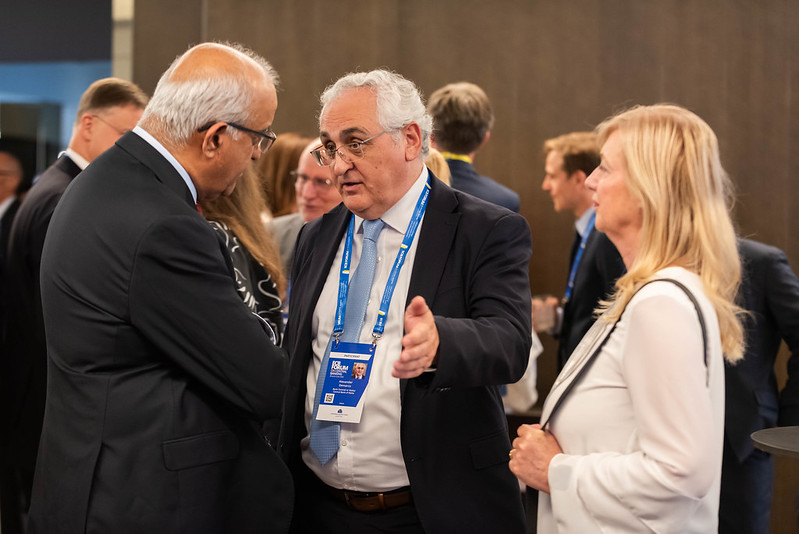
By Marta Vilar and David Barwick – VALLETTA (Econostream) – European Central Bank Governing Council member Alexander Demarco said higher-than-expected underlying inflation could justify another rate hike before second-round effects become visible, while a combination of adverse inflation and energy developments could make an October move compelling.
“If underlying inflation is turning out higher than expected for other reasons, that could be grounds to act,” the governor of the Central Bank of Malta told Econostream in an interview Monday (transcript here). Demarco distinguished such a development from a temporary increase caused by a tax change, saying a more persistent surprise could require an upward revision to the ECB’s inflation outlook.
A significant deviation that could not otherwise be explained might indicate that indirect effects of the energy shock were arriving sooner or proving stronger than expected, he said. The ECB would also examine wage trackers and labor-market developments rather than rely on a single inflation reading, he said.
Asked what would make an October hike compelling, Demarco cited “a very negative surprise in underlying inflation,” a further increase in energy prices and higher medium-term inflation expectations. Together, those developments “would be a compelling case to act in October,” he said.
On the choice between October and December, “I would not exclude anything,” Demarco said. “The absence of new projections doesn’t mean we cannot act.” Policymakers would examine the latest data and probably update their internal assessment of energy price scenarios, including the prices of natural gas, petrol and diesel paid by consumers, he said.
“Another energy price shock could also be a reason to act in October,” Demarco said. He pointed to talk of a possible U.S. ban on diesel exports, which he said “could have serious implications for prices.”
A substantially larger rate increase than the ECB’s 25bp steps so far would require more severe developments. “Really sizeable negative inflation surprises and a further energy price shock” could suggest that the ECB’s adverse or severe scenario was becoming more likely, Demarco said. “Then we would probably have to hike in larger steps.” Absent such surprises, he said did not “see the need to be that aggressive.”
So far, inflation has come in below expectations and wage inflation has declined, limiting the apparent risk of second-round effects, according to Demarco. But he saw little prospect of the conflict in Iran ending soon and warned that prolonged high energy prices could eventually prompt households to demand higher wages.
Demarco called the recent rise in long-term bond yields “quite worrying,” particularly for heavily indebted countries, and urged “[g]reater fiscal prudence.” Higher funding costs could weaken growth and lead to more nonperforming loans, he said.
Still, markets had already priced in an ECB hike, according to Demarco. “I don’t think 25bp in October or December would surprise them or have a major impact on government bond yields,” he said. The ECB also had to signal its resolve to meet its price-stability objective “if conditions demand so,” he added.
Demarco cautioned that “you have to be cautious about raising rates too quickly and hampering growth,” describing the economic situation as “quite fragile.” In his assessment, rates are now at the upper end of the neutral range, while “a hike to 2.75% would start pushing us into restrictive territory.”
Separately, Demarco praised the Federal Reserve’s latest rate increase as “a very good decision for the USA.” The move was politically courageous so close to an election and gave the Fed chair “credibility that had been in question since his appointment,” he said.