
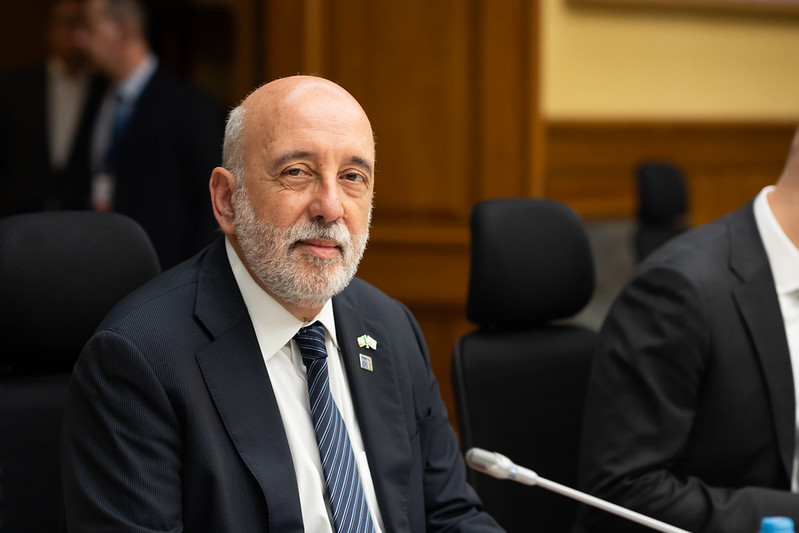
By David Barwick – FRANKFURT (Econostream) – The Ireland-Palestine Solidarity Campaign has asked the International Criminal Court to investigate European Central Bank Governing Council member Gabriel Makhlouf, who heads the Central Bank of Ireland, over the Irish central bank's role in regulating the sale of Israeli government bonds in the European Union.
The IPSC lodged a 102-page submission with the ICC on Wednesday under Article 15 of the Rome Statute, according to the group’s website.
The submission alleges that Makhlouf contributed to or aided and abetted what the IPSC characterizes as Israel's genocide in Gaza through his role at the Central Bank of Ireland, which for most of the period since the Hamas-led October 7, 2023 attack on Israel regulated the sale of Israeli state bonds in the EU.
The submission further argues that Makhlouf could have used powers under Article 42 of the EU Markets in Financial Instruments Regulation to prohibit or restrict the marketing and distribution of the bonds.
Makhlouf has repeatedly rejected the contention that the Irish central bank can use its prospectus-approval role to make broader political or international-law judgments about an issuer.
He told an Irish parliamentary committee in July that the EU Prospectus Regulation was a disclosure regime and that the central bank was required to approve a prospectus if it met the regulation's standards of completeness, comprehensibility and consistency.
Approval did not constitute endorsement of either the issuer or the securities, he said.
Makhlouf also noted that Israel was not subject to EU sanctions restricting its ability to issue securities, unlike Russia following its invasion of Ukraine.
The complaint meanwhile comes from an organization that has demonstrably misrepresented a central ICJ ruling while invoking international law to advance its campaigns. The IPSC's campaign against the Central Bank of Ireland continues to state on its website that the ICJ in January 2024 "confirmed the plausibility of the charge of genocide against Israel."
The ICJ found that at least some of the rights asserted by South Africa were plausible, including the right of Palestinians in Gaza to be protected from acts of genocide, and that there was a real and imminent risk of irreparable prejudice to those rights. It did not determine that the allegation that Israel was committing genocide was itself plausible.
Joan Donoghue, who was president of the ICJ when the order was issued, later expressly rejected the IPSC’s interpretation, saying the court “didn't decide that the claim of genocide was plausible.”
Notably, the IPSC's latest submission itself uses the narrower and accurate formulation from the ICJ order, in contrast to the false claim the organization continues to make in its public campaign literature about what the court decided.
The IPSC's response to the Hamas-led attack of October 7, 2023 raises more fundamental questions about the consistency with which it applies the human-rights principles it invokes.
In a statement published the day after the attack, as the mass killing and abduction of Israeli civilians was becoming clear, the IPSC did not condemn attacks on civilians or hostage-taking.
Instead, it described Palestinian militants as engaging in "anti-colonial violence in retaliation," blamed the situation on Israeli and Western conduct and invoked the right of occupied peoples to fight colonial domination and alien occupation.
By framing the violence principally as anti-colonial resistance without making clear that such resistance must not extend to deliberately attacking civilians or taking hostages, the IPSC failed to apply human rights and international law principles consistently.
The group has also faced longstanding criticism over tactics used in its cultural boycott campaigns.
While none of this in itself determines the legal merits of the submission concerning Makhlouf, it eviscerates any presumption that the IPSC can be treated as a reliable interpreter of international law.