
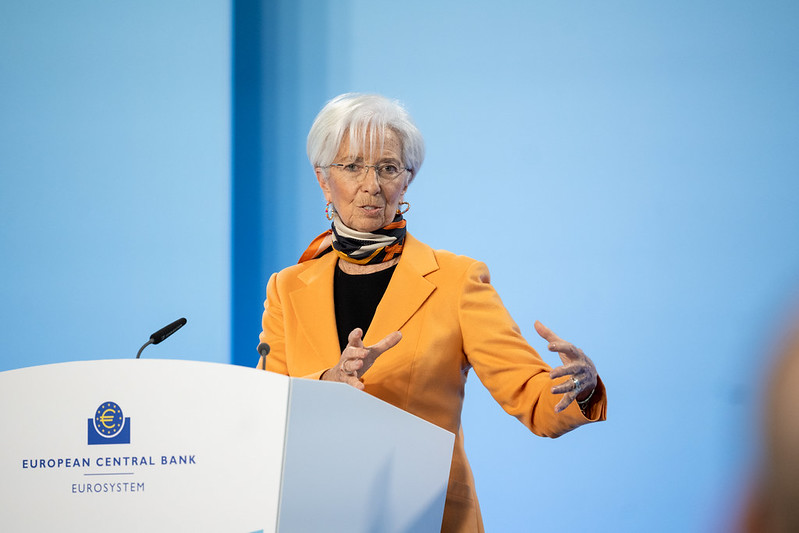
By David Barwick – FRANKFURT (Econostream) – European Central Bank President Christine Lagarde on Wednesday said Europe’s leaders had to act on former ECB President Mario Draghi’s diagnosis of the bloc’s weaknesses, warning that Europe’s unfinished institutional architecture was being tested by a harsher global environment.
In a speech in Aachen, Germany, at the dinner preceding the Charlemagne Prize ceremony honoring Draghi, Lagarde praised her predecessor’s role in defending the euro during the sovereign debt crisis and his later report on European competitiveness.
Draghi had shown that European competitiveness was about more than economics, Lagarde said. It was also about whether Europe could preserve prosperity and remain in control of its own future, she said.
“Europe now finds itself in a world that is far less forgiving of the gaps in its institutional architecture,” she said.
Draghi’s competitiveness report had identified weaknesses including an incomplete Single Market, fragmented energy markets, segmented capital markets and defense industries still divided along national lines, Lagarde said.
“Mario can diagnose the problem,” she said. “He can use his authority to break complacency. But he cannot, from outside office, build the institutions that Europe lacks.”
That duty now fell to Europe’s political leaders, Lagarde said.
“That responsibility lies with Europe’s leaders,” she said.
Lagarde said Draghi had followed a tradition of European statesmanship also represented by Jean Monnet, Robert Schuman and Jacques Delors.
As ECB president during the sovereign debt crisis, Draghi’s commitment to do “whatever it takes” to preserve the euro marked the point at which the central bank made clear that the single currency was irreversible, Lagarde said.
His intervention had also bought Europe time to strengthen fiscal rules, create new crisis mechanisms and begin the banking union, she said.
Lagarde said each generation of European leaders faced its own test, and current leaders now had to decide whether the present moment would become a missed opportunity or another step in Europe’s construction.
“What they need is the courage to act,” she said.