
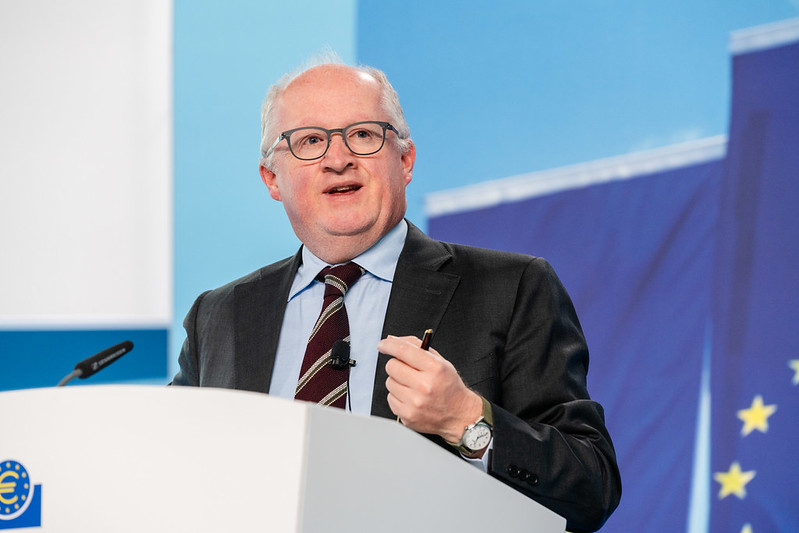
By David Barwick – FRANKFURT (Econostream) – European Central Bank Chief Economist Philip Lane said Tuesday that climate change and the green transition increasingly mattered for monetary policy, but that the ECB could not apply a uniform response to climate-related shocks.
In a keynote speech at an ECB conference in Frankfurt, Lane said climate change affected output, inflation, monetary transmission and the neutral interest rate, while the green transition could create both short-term costs and longer-term resilience.
Climate-related shocks posed a challenge because physical climate events tended initially to act as adverse supply shocks, pushing output lower and inflation higher, he said.
Recent research on extreme temperature events in Europe over more than a century showed that such shocks tended to create a tradeoff between price stability and supporting the economy, Lane said.
At the same time, climate shocks could also weigh on demand by reducing wealth and income, tightening financing conditions, lowering collateral values and damaging confidence, he said.
This may explain why central banks had historically eased monetary policy in response to episodes of abnormally high temperatures, Lane said.
However, historical patterns did not imply a uniform policy prescription, he said.
“[I]f climate-related shocks grow more frequent and salient, the risk of de-anchored inflation expectations becomes more acute,” Lane said. “If so, always looking through climate-driven supply shocks may not always present the most appropriate choice.”
How climate-related disruptions fed through to inflation and the economy over the medium term remained highly uncertain and depended on the scale, persistence and type of shock, as well as the initial conditions, he said.
“This uncertainty calls for a data-dependent, case-by-case approach to determining the policy response,” Lane said.
Transition policies to meet the EU’s 2030 emissions target were likely to lower growth and boost inflation in the short term, according to Lane.
If the EU’s 2030 emission-reduction target were met solely through higher carbon taxes, the impact on inflation would peak at 0.4pp above baseline in 2027 and remain elevated until 2030, he said.
A broader Fit for 55 policy mix, involving carbon taxes and non-tax measures, would increase inflation somewhat less in 2027 and 2028, Lane said.
The ECB’s December 2025 baseline assumed that the introduction of ETS2, the EU’s new emissions trading system for road transport, building heating and small industrial installations, would add around 0.2pp to Eurozone headline inflation in 2028, he said.
Still, the current energy shock also showed the potential of renewable and nuclear electricity to shield consumers from fossil-fuel price shocks, Lane said.
Since the start of the Iran war at the end of February, crude oil, natural gas and refined diesel prices had risen sharply, pushing Eurozone energy inflation from -3.1% in February to 5.1% in March and 10.9% in April, he said.
However, electricity prices had reacted less to the latest shock in countries with higher shares of renewable or nuclear electricity, Lane said.
A green transition that reduced dependence on fossil-fuel imports could bring a “triple dividend” by cutting greenhouse gas emissions, reducing the impact of global energy shocks on inflation and increasing energy security, he said.
Climate factors could also affect monetary transmission, Lane said.
They could influence financial conditions independently of monetary policy and alter how firms, households and financial intermediaries reacted to the policy stance, he said.
Eurozone banks were already accounting for climate considerations in credit allocation, with easier lending conditions for low-emission firms or firms with credible decarbonization plans and tighter conditions for high-emitting firms without such plans, Lane said.
Banks also tended to charge higher lending rates to high-emission firms and to firms without credible emission-reduction targets, he said.
Climate change and transition policies could affect the neutral real interest rate, but the net direction of the impact remained uncertain, Lane said.
Climate damages could lower productivity growth and increase precautionary saving, tending to depress the neutral rate, while green-transition investment and clean-technology innovation could push it higher, he said.
The ECB had revised two elements of its monetary policy toolbox in response to climate considerations, Lane said.
The Eurosystem had introduced a framework tilting corporate asset purchases toward issuers with better climate performance and had decided in July 2025 to introduce a collateral-framework measure from the second half of 2026 to better manage climate-transition-related financial risks, he said.
Adjusting the ECB’s portfolio composition and collateral framework to reflect climate risks was a “mandate-consistent response, not an extension of the mandate,” Lane said.
“In the context of high uncertainty about the precise timeline for global warming, a data-dependent approach provides the best framework for monetary policy decisions,” he said.