
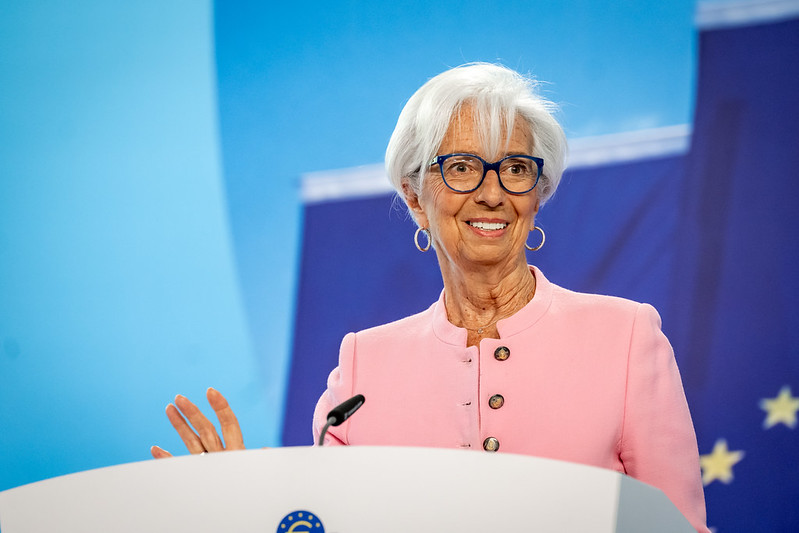
By David Barwick – FRANKFURT (Econostream) – European Central Bank President Christine Lagarde said Tuesday that climate and nature risks had become increasingly relevant for monetary policy and required deeper, fact-based analysis as the green transition lost momentum and became more politically contested.
In introductory remarks at a conference in Frankfurt, Lagarde said central banks had made substantial progress in understanding how climate change affected the macroeconomic environment in which monetary policy operated, though knowledge remained incomplete.
“The past decade has thrown up a troubling paradox: every new data point tells us to accelerate the green transition – and yet it is losing pace,” she said.
The implications of climate change for central banks had initially been discussed mainly in relation to financial stability, while the monetary policy consequences came into focus more slowly, Lagarde said.
Extreme weather events showed why the impact on inflation was not always clear in advance, she said.
A shock that disrupted agricultural production could push up food prices, with last summer’s heatwave estimated to have added as much as 0.7pp to unprocessed food prices in the Eurozone after one year, Lagarde said.
At the same time, such events could weigh on output, and probably more persistently than once thought, she said.
ECB research had found that four years after a drought or flood, regional output remained depressed by around 3pp on average, she said.
If extreme weather shocks hit entire economies, weaker activity and incomes could dampen demand and potentially put downward pressure on headline inflation, according to Lagarde.
Central banks had also been able to examine how decarbonization shaped the macroeconomic environment, including its implications for inflation, she said.
The rollout of ETS2, which extends carbon pricing in the EU to buildings and road transport, was already included in ECB macroeconomic projections and was estimated to add around 0.2pp to Eurozone headline inflation in 2028, Lagarde said.
The ECB’s 2021 strategy review had been based on extensive analysis of how climate change interacted with the central bank’s price stability mandate, she said.
That review committed the Eurosystem to incorporating climate change considerations systematically into monetary policy and central banking, while last year’s strategy assessment extended the commitment to nature, Lagarde said.
The ECB’s climate roadmap had covered stress-testing exercises, risk assessment, corporate bond holdings and the collateral framework, and had been largely delivered, according to Lagarde.
Recent work on nature-related risks showed that an extreme episode of water scarcity could put as much as 24% of Eurozone output at risk, she said.
Findings of that kind underlined the scale of the risks, but the broader response from governments and societies had fallen short, Lagarde said.
The past decade was the warmest on record, the rate of sea-level rise had doubled since satellite measurements began, and scientists now considered it likely that the world would breach the Paris Agreement’s 1.5C limit within five years, she said.
Still, global carbon emissions from fossil fuels hit a record high last year, and some jurisdictions had seen backtracking, Lagarde said.
Climate change had itself become partisan, even though it struck “regardless of political disposition,” she said.
In Europe, some debate had focused on whether the green transition had made the continent more vulnerable in a geopolitically volatile world by increasing energy bills, Lagarde said.
“But the status quo is clearly unsustainable,” she said.
Europe imported roughly 60% of its energy, almost all of it fossil fuels, and current surging energy prices were a reminder of the cost of that dependency, Lagarde said.
Alternative energy sources offered the clearest path to minimizing trade-offs between security, sustainability and affordability, she said.
ECB analysis of the current energy shock showed that countries where a higher share of electricity came from non-fossil fuel sources, such as Spain and Portugal, had been more insulated from the rise in gas prices, she said.
The transition needed to be approached in economically efficient ways so that growth and decarbonization could advance together, Lagarde said.
In moments when the climate debate became louder and less clear-eyed, rigorous work by researchers and central banks mattered most, she said.
“The world needs the kind of impartial, fact-based analysis that these communities provide – to cut through the noise and help policymakers and citizens alike understand the signals and what is at stake,” Lagarde said.
Climate and nature risks were deeply uncertain, making preparation essential, she said.