
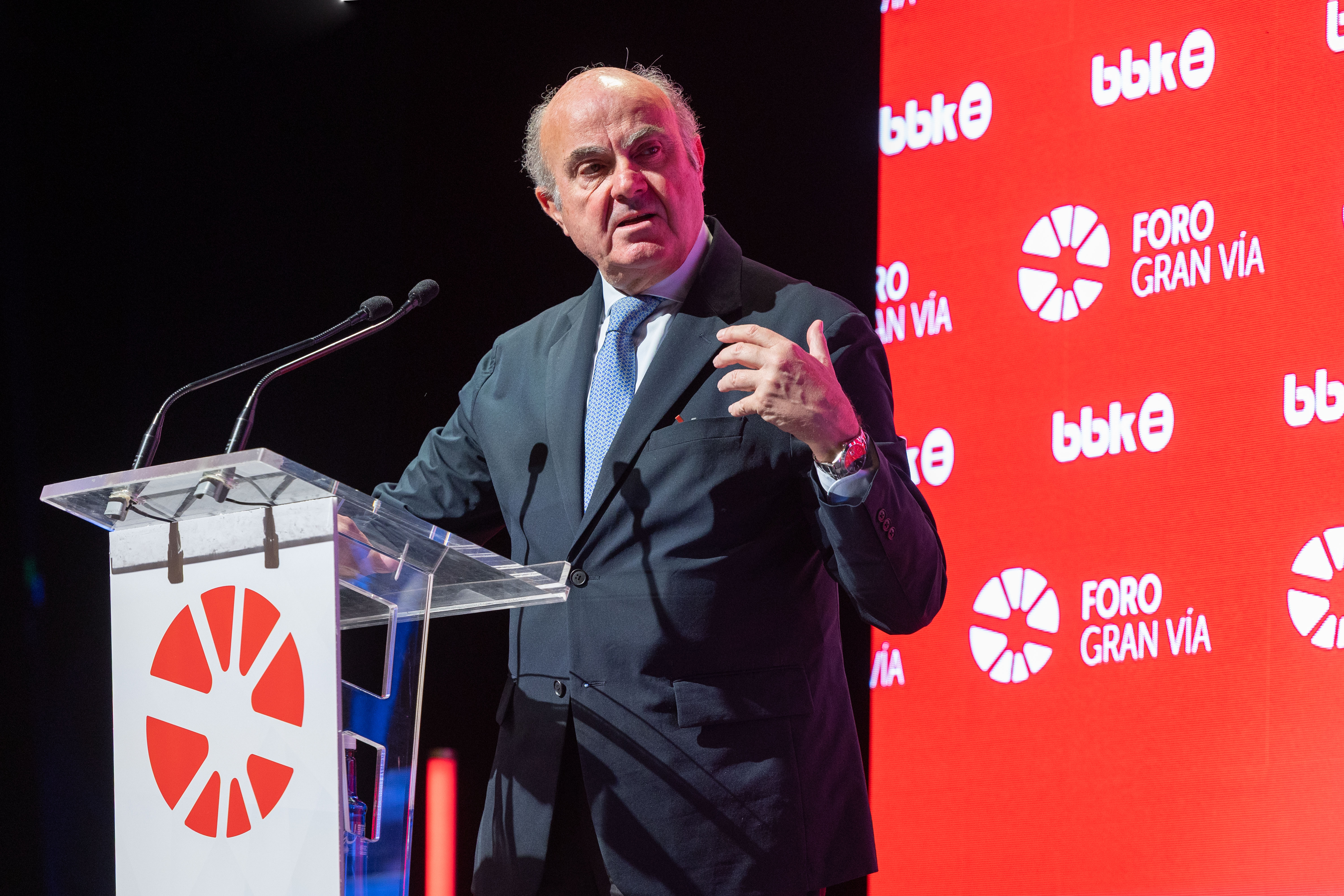
By David Barwick – FRANKFURT (Econostream) – European Central Bank Vice President Luis de Guindos said Monday that the current economic situation was highly uncertain because of the Middle East war and volatile energy markets.
In introductory remarks to the European Parliament’s Committee on Economic and Monetary Affairs, de Guindos said the Governing Council remained data-dependent and would continue deciding policy meeting by meeting.
“The current economic situation is highly uncertain in light of the war in the Middle East, and energy markets remain volatile,” he said.
The Governing Council had kept interest rates unchanged at last week’s meeting and would monitor developments carefully to deliver on its price stability mandate, he said.
De Guindos was presenting the ECB’s Annual Report for 2025 to the Committee for the final time before his eight-year term as vice president ends later this month.
The Eurozone economy had experienced a moderate and broad-based recovery in 2025 despite a challenging global environment, with growth picking up to 1.4%, he said.
Growth had been partly boosted by strong exports in 1Q, reflecting frontloading ahead of expected higher U.S. tariffs, according to de Guindos.
After that momentum faded, domestic demand sustained growth and helped counter external headwinds amid elevated uncertainty, he said.
A robust labor market, moderating inflation and the effects of ECB interest rate cuts also supported the recovery, de Guindos said.
Disinflation remained broadly on track in 2025, with Eurozone inflation averaging 2.1%, close to the ECB’s 2% medium-term target, he said.
Progress on inflation and a favorable inflation outlook allowed the Governing Council to cut the deposit facility rate by another 100bp to 2.0% by mid-2025, where it had remained since, he said.
The ECB’s 2025 monetary policy strategy assessment reaffirmed the symmetric 2% inflation target and recognized the importance of an appropriately forceful or persistent response to large and sustained deviations from the target in either direction, de Guindos said.
The assessment also underlined the importance of considering not only the most likely path for inflation and growth, but also surrounding risks and uncertainty, including through the active use of scenarios, he said.
Beyond monetary policy, de Guindos said the ECB had advanced to the next phase of the digital euro project, focused on technical readiness, market engagement and the legislative process.
The ECB aimed to be ready for a digital euro pilot in 2027 and a potential first issuance in 2029, assuming the required regulation was adopted in 2026, he said.
The ECB had also continued work on a strategy for a tokenized European financial ecosystem, including the Appia initiative on architecture and the Pontes initiative on settlement in central bank money of wholesale DLT-based financial transactions, he said.
That strategy supported efficiency and innovation, strengthened the EU’s strategic autonomy and created an opportunity to design integrated market infrastructures from the ground up, de Guindos said.
Further progress on the savings and investments union and completion of the banking union remained important, he said.
De Guindos said the euro area had shown resilience since he joined the ECB in 2018, with Bulgaria joining the Eurozone this year and public support for the single currency reaching record levels.
“[W]hatever the future may bring, the ECB will remain firmly committed to its mandate of price and financial stability – a foundation of Europe’s prosperity and strength,” he said.