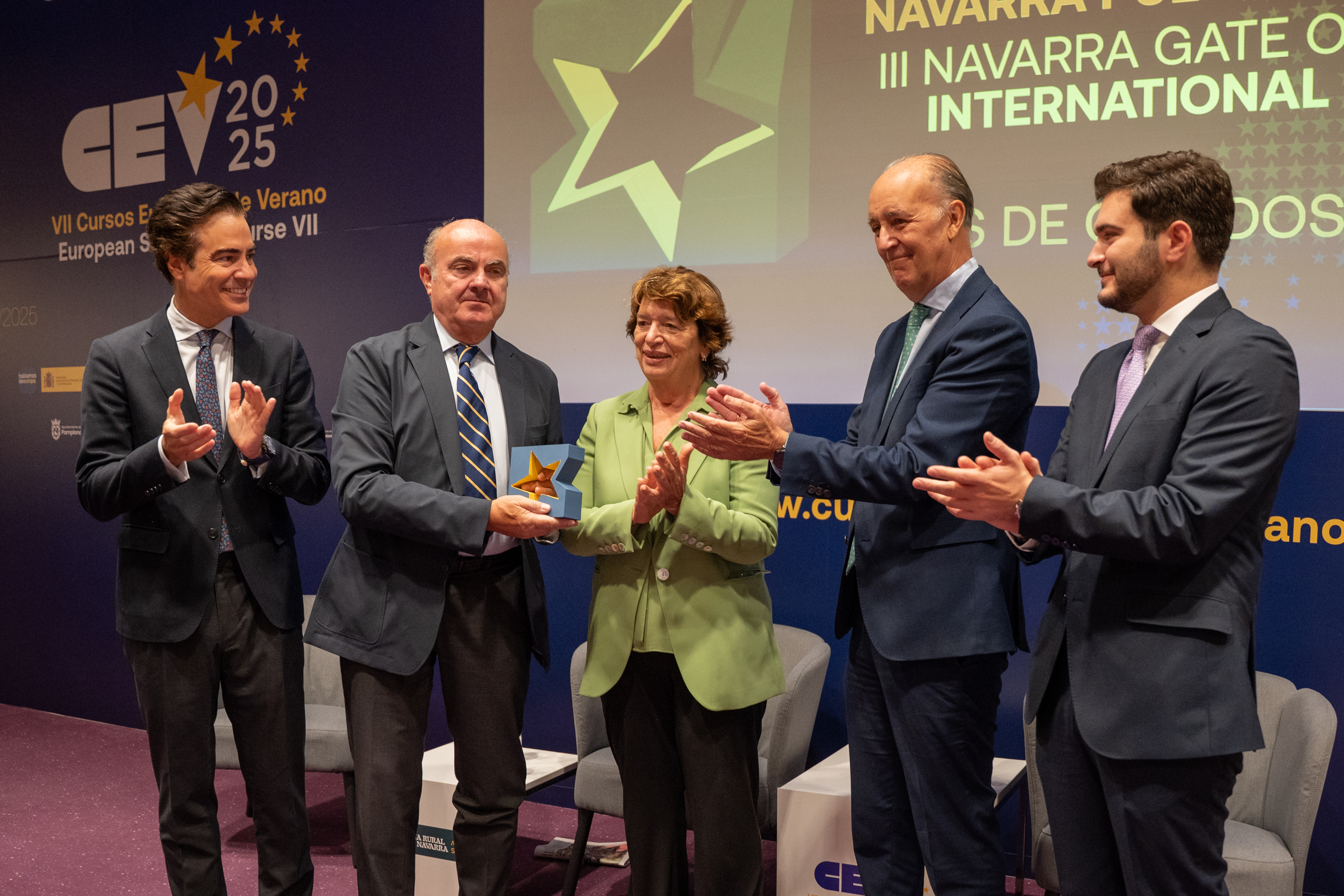
By David Barwick – FRANKFURT (Econostream) – European Central Bank Vice President Luis de Guindos on Sunday said the current inflation shock was very different from that of 2021 and 2022 and that the ECB had been right to wait before deciding on any interest rate hike.
In an interview with Spanish daily El País, de Guindos said the Eurozone was now facing a geopolitical conflict rather than the combination of post-pandemic reopening, expansionary fiscal policy, large-scale central bank liquidity and negative interest rates seen earlier in the decade.
“We are now in the midst of a geopolitical conflict and we have to keep a cool head,” he said. “That’s why I fully agree with Thursday’s decision.”
“It would be a mistake to apply what happened in 2021-22 to the current situation, but there is also a huge level of uncertainty and it’s important to reach a consensus,” he added.
De Guindos said the economic effects of higher energy prices tended to show up in inflation data faster than in growth data.
The impact of the war was not yet visible in first-quarter data for either the Eurozone or Spain, but forward-looking indicators were beginning to point to a strong impact, he said.
“Confidence, for example, has deteriorated very significantly,” he said.
Turning to his home country, he said that Spain’s macroeconomic figures were good, but that issues such as per-capita income, productivity and housing also had to be considered.
More could also have been done to reduce the budget deficit, according to de Guindos.
However, Spain benefited from a financial system that was not a cause for concern and from being a competitive economy, he said.
“It is well prepared for a slowdown, which will be clear and marked, because Spain cannot escape this environment,” he said.
Asked whether Spain was being too optimistic, de Guindos said governments had to be optimistic and that it was important to convey such a message.
The world had changed greatly since he joined the ECB in 2018, he said.
Europe had finally understood that it needed to become more independent, starting with defense but extending to technology, payment systems, cloud services and artificial intelligence, he said.
The new U.S. administration represented a paradigm shift not only on tariffs but also in areas such as banking regulation and crypto-assets, de Guindos said.
Joint European financing would be particularly important for defense spending, he said.
The first joint debt issuance under Next Generation EU had had a major impact on sentiment at a difficult moment, and Europe should take pragmatic steps in the same direction, he said.
European banks’ capital levels did not constrain lending to the economy, de Guindos said.
The solvency of the European banking sector was one of Europe’s few structural advantages and should not be weakened, he said.
The ECB was the clearest example of the benefits of European integration, with a common monetary policy and common banking supervision, he said.
When inflation was above 10%, Europeans still expected it to return to 2% because of the ECB’s credibility, de Guindos said.
On Spain’s future representation on the ECB Executive Board, de Guindos said the presidency would be the best outcome but that the key issue was for Spain to have a seat.
Spain was the Eurozone’s fourth-largest economy, and he was convinced it would secure a Board seat, he said.
The ECB presidency was decided differently, however, and was a political matter for the European Council, de Guindos said.
De Guindos did not clearly back the idea that former Banco de España Governor Pablo Hernández de Cos was likely to succeed ECB President Christine Lagarde.
“Pablo was a good governor, even though it’s true that it was Luis Linde and Fernando Restoy who oversaw the entire bank restructuring process,” he said.
Asked whether he had become less hawkish during his time at the ECB, de Guindos said he regarded himself as being in the middle.
He had been more hawkish in 2022 and among the first to argue that rates would have to rise and that inflation was more persistent than the ECB had been saying, he said.
“Now, at the end of my time here, I would say that I lean more towards prudence,” he said.
He would not return to politics or move to the banking sector after leaving the ECB, he made clear.
Rather, he said, he would join the University of Comillas’ Faculty of Economics and Business Studies as professor of European political economy and would also work with IESE Business School.