
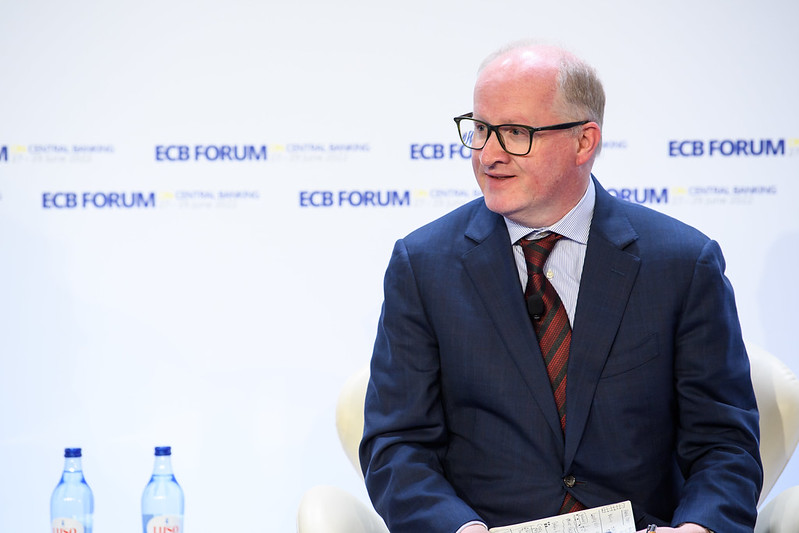
By David Barwick – FRANKFURT (Econostream) – European Central Bank Chief Economist Philip Lane on Wednesday argued that the Eurozone suffers from an “undersupply of euro-denominated safe assets,” calling for a larger stock of common debt and other instruments that could deepen market liquidity, strengthen financial stability, and reinforce the euro’s international role.
In a speech in Frankfurt, Lane said a benchmark safe asset was a “foundational element of any autonomous monetary system,” but that the current design of the Eurozone’s financial architecture left the bloc without enough highly liquid euro-denominated assets to meet domestic and global demand.
“The current design of the euro area financial architecture results in an undersupply of euro-denominated safe assets,” he said.
Because Germany’s Bund remains the main de facto euro-denominated safe asset, the available stock is too limited relative to the size of the Eurozone and the global financial system, he argued.
At the same time, Lane said the broader universe of national sovereign bonds could only partially fill that role. While common factors had come to play a larger role in the Eurozone bond market and inter-country spread volatility had fallen, “the remaining scope for relative price movements across these bonds means that the overall stock of national bonds does not sufficiently provide safe asset services.”
One route to expanding the supply would be greater issuance of common bonds backed by the combined fiscal capacity of European Union member states, he said. Existing EU bonds were “simply too small” in volume to generate the liquidity, derivatives markets and repo markets needed for a true safe asset.
In Lane’s view, joint borrowing would make sense both for investment in European public goods and for common policy priorities such as support for Ukraine.
“There are several ways to expand the stock of common bonds,” he said. “Just as the NGEU program was financed by the issuance of common bonds jointly backed by the Member States, these countries could decide to finance investment in European-wide public goods through more common debt.”
Another possibility would be to generate a larger stock of safe assets from the existing pool of national bonds, including through a revival of the “blue bond/red bond” approach or through sovereign bond-backed securities, Lane said.
Set against those options, he warned that any expansion of common debt would depend on political will and mutual trust, while also requiring continued fiscal discipline at national level.
“Further progress in expanding the stock of joint debt in Europe ultimately depends on sufficient political will and mutual trust,” he said. “This includes full and shared recognition that the safety of common debt relies on the robust and demonstrable commitment of all Member States to maintain sustainable national debt paths.”
Lane also linked the safe-asset issue to broader efforts to deepen European capital markets, arguing that a larger stock of euro safe assets would complement the savings and investment union agenda and help foster greater global demand for euro-denominated assets.