
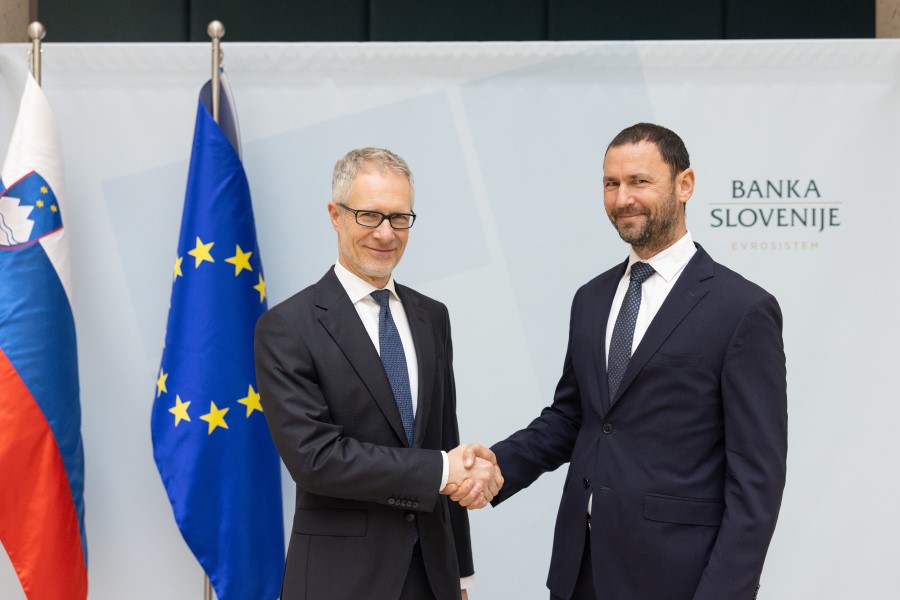
By David Barwick – FRANKFURT (Econostream) – European Central Bank Governing Council member Primož Dolenc on Thursday said lower energy prices following the recent truce in the Iran war had moved the euro area economy back toward the ECB’s baseline scenario and could mean no rate hikes will be needed.
Dolenc, who heads the Bank of Slovenia, told Bloomberg that policymakers still had to keep an open mind, but that current market developments were not pointing toward the kind of prolonged shock that would justify tighter policy.
“For me, the baseline scenario is that this is an exogenous supply shock where inflation won’t be higher in the medium term,” Dolenc said. “In this case, we won’t have any interest rate hikes.”
He said the situation remained uncertain and that officials were still evaluating the fallout for inflation and growth ahead of the April 30 policy meeting.
“We are still in unclear waters in terms of how the economy will proceed,” Dolenc said. By the time of the ECB’s June meeting, things would be considerably clearer, he said.
Dolenc also cautioned against reading too much into the March staff projections’ incorporation of market expectations for two rate increases in 2026.
“Just because the market expected hikes when we put together the projections doesn’t mean we will need to do them,” he said.
He said the present backdrop differed sharply from that of 2022, when the inflation shock following Russia’s invasion of Ukraine hit an economy in a very different position, and argued that policymakers now had somewhat more time to assess the consequences.
At the same time, Dolenc said the ECB was ready to act sooner if conditions worsened materially and the economy began moving toward the adverse or severe scenarios.
“If we see that the situation is deteriorating, converging to the adverse or even the severe scenario, that there is no way that the conflict will end, then maybe a signal that acting sooner rather than later might be a solution,” he said.
He said he would support moving before June if there were clear evidence of a large and persistent energy shock that threatened to push inflation above 2% over the medium-term horizon.
“But what we see right now from the markets and inflation expectations, is that we are not approaching this scenario,” he said.