
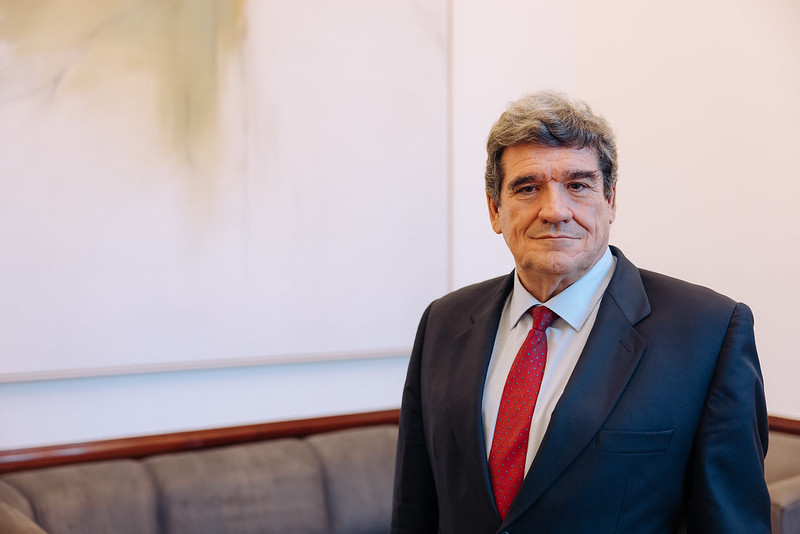
By David Barwick – WASHINGTON (Econostream) – European Central Bank Governing Council member José Luis Escrivá on Wednesday said long-term inflation expectations had so far remained broadly stable despite the Iran war shock, while warning that central banks were operating under “extremely high uncertainty.”
Escrivá, who heads the Banco de España, spoke at the Peterson Institute on “Central Banking for Open Economies in a Changed World,” listing “robust policy under high uncertainty” among the main challenges facing central banks.
“So far we haven’t seen too much change,” Escrivá said of inflation expectations, sharing a slide that showed “broadly unchanged long-term inflation expectations (5y5y swaps),” with the measure at 2.0 before the conflict on February 27 and 2.1 on April 13.
He added that policymakers needed “more than ever to monitor data in real time,” echoing slides that said central banks should “monitor with real time data” and, when the outlook remained unclear, “give more weight to incoming data vs. central forecast.”
His presentation argued that, under so-called Knightian uncertainty, “modal projections likely misguided,” while under fat-tailed risks “balance of risks and asymmetry of policy mistakes are crucial.”
Using oil price data, Escrivá described the 2026 Iran-war shock as a “historical tail event,” noting that it had led to a 42% increase in real oil prices after two weeks, compared with 5% after the 2022 Ukraine shock.
Scenario design, he said, had to cover the full risk space. Slides presented adverse and severe cases extending beyond the central market-based baseline, with tail scenarios incorporating additional shocks as well as “asymmetries” and “non-linearities.”
For internal discussions, the presentation said, policymakers should analyze alternative monetary and fiscal reactions across all scenarios. For external communication, however, it said there should be “no monetary policy change assumption beyond technical assumptions,” while fiscal responses could be included when feasible.
Another slide framed the policy choice as one between “early, gradual tightening” and “wait-and-see, then decisive action,” with the former offering smoother paths and better-anchored expectations but risking unnecessary drag, and the latter allowing more information to be gathered at the cost of a possible behind-the-curve response.
A separate chart showed that, following the ceasefire announcement, the “probability of a quick resolution dominates since agreed ceasefire.” Where it remained unclear whether events still validated the baseline, his presentation said, policymakers should update scenarios and lean more heavily on incoming data.
On communication, Escrivá warned against both too few and too many scenarios, as too narrow a set could create false precision, while too many could obscure the main narrative and complicate expectation formation.