
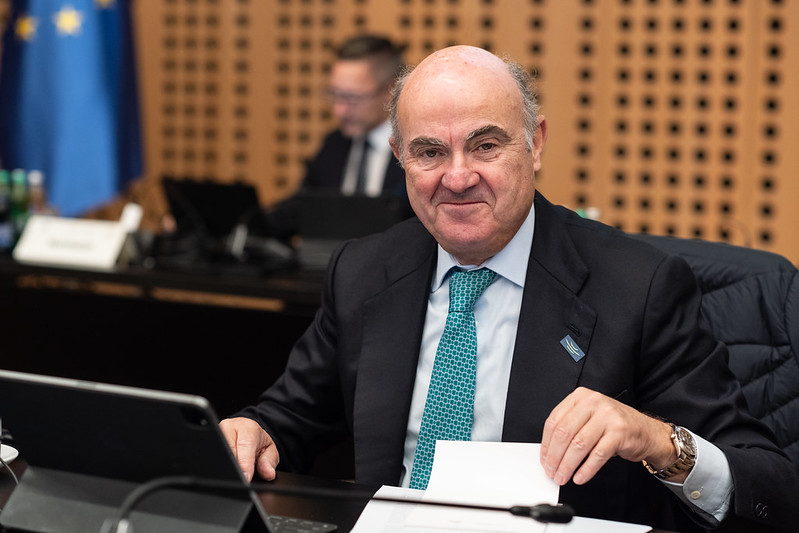
By Marta Vilar – SORIA, Spain (Econostream) – European Central Bank Vice President Luis de Guindos said on Friday that the euro area outlook would move closer to the ECB’s baseline scenario if the Middle East conflict results in a peace agreement and the reopening of the Strait of Hormuz.
During a Q&A at the Cámara de Comercio in Soria, de Guindos said that events that had already occurred would have an impact on both inflation and growth.
“The question is how intense this negative impact is going to be, and that will depend on the evolution of the conflict,” he added.
“We will meet again, as I was saying before, at the end of April to analyze it, and there we will have more information about the conflict. If it evolves positively in the sense of a peace agreement, a reopening of the Strait of Hormuz, etcetera, then obviously the situation will be much, much better. We will be closer to our central scenario,” he said.
However, de Guindos cautioned that the situation remained highly uncertain. “We see new signals every day,” he said, noting that without a peace agreement and reopening of the strait, “we would be facing a different scenario.”
He also pointed out that the ECB could not prevent the initial inflationary impact stemming from higher oil prices, which was already reflected in recent data.
Uncertainty around the conflict could generate an increase in inflation expectations, he said. “And then there, obviously, the central bank has to act.”
“That is why second-round effects are heavily impacted by what happens in the conflict,” he said. “The evolution of the war will determine the evolution of interest rates.”
Regarding the April Governing Council meeting, de Guindos said policymakers would first need to “gather and assess incoming information,” which he said would be closely tied to developments in the conflict.
Related articles:
- ECB’s de Guindos: No Signs of Inflationary Spiral Yet; Inflation Expectations “Relatively Contained”