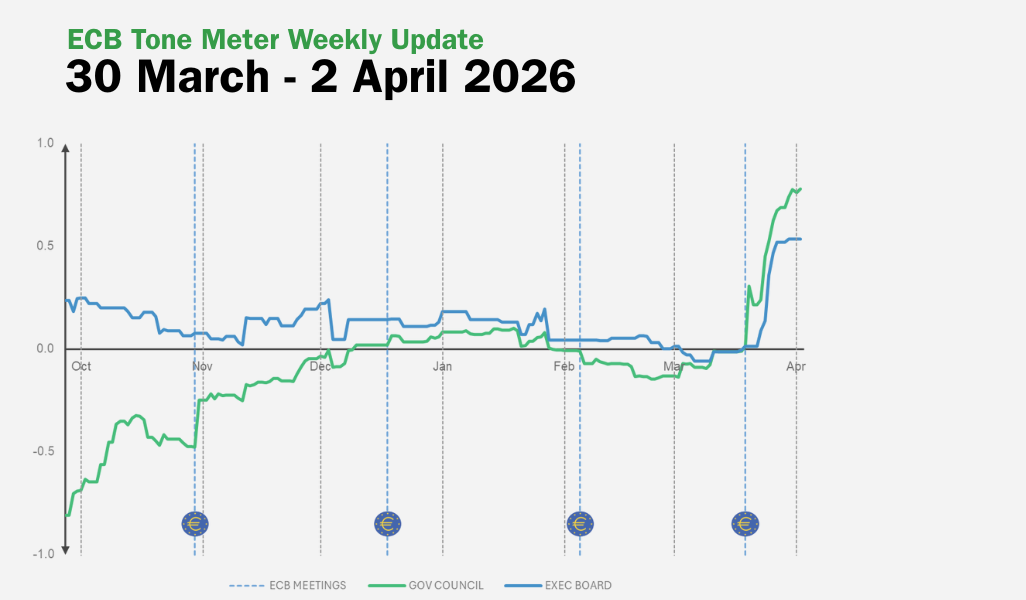
By David Barwick – FRANKFURT (Econostream) – Less than a week after the European Central Bank left rates unchanged and Christine Lagarde stressed uncertainty, the ECB president on Wednesday sounded somewhat more hawkish.
With the next ECB rate decision more than a month off, the key question is whether her rhetoric is evolving in a way consistent with greater willingness to keep tightening on the table. By that standard, we see her speech as the kind of escalation one would expect relative to last Thursday’s press conference: still cautious and noncommittal, but more concrete about the intellectual and communicative groundwork that might underpin a hike.
On March 19, Lagarde said the Iran conflict had made the outlook “significantly more uncertain” and would have a “material impact” on near-term inflation; the Governing Council would assess the incoming information meeting by meeting without pre-committing to a rate path. That was enough to leave April wide open, but it was more the language of watchfulness than preparation.
With the underlying shock persisting and any eventual April move still likely to be signaled only gradually, Lagarde used Wednesday’s speech to lay out an escalation ladder for how the ECB should react to an energy shock.
She explicitly said that as deviations from target grow “larger and more persistent,” the case for action becomes stronger; that a large but not-too-persistent overshoot could justify “some measured adjustment”; and that a significant, persistent deviation would require a “forceful or persistent” response.
In other words, she explained in considerable detail why a central bank should not simply sit on its hands if the inflationary consequences of the shock broaden. Her warning that “to leave such an overshoot entirely unaddressed could pose a communication risk” was especially telling because it implied that delay can also entail costs.
Also important was the shift in tone around persistence. At the press conference, Lagarde spoke in the standard conditional language of monitoring. Today, she argued that the current disruption was the largest “in the history of the global oil market”; warned that “the likelihood of a quick normalization is diminishing”; noted that “[a] further cliff edge is also approaching” as “the full impact of lost supply is only about to be felt”; and stressed that firms and workers might react faster this time because the memory of high inflation is still fresh.
To be sure, she devoted substantial space to why this episode might prove less inflationary than 2022. The initial shock has so far been smaller, the macro backdrop is more benign, policy is no longer highly accommodative, and weaker confidence could help limit pass-through.
But those caveats look less like a softening of the message than like the academic rigor expected in a keynote speech at this type of conference, and like the necessary escape hatches of a policymaker who was not going to trap the ECB in a single narrative five weeks before a meeting.
The absence of an overt April signal was thus a given, not evidence that prospects for a hike at the end of next month are fading. At this stage, Lagarde needs to ensure that, if the geopolitical situation fails to improve and the shock continues to look persistent, a move on April 30 will not come as a conceptual shock. Wednesday’s speech served exactly that purpose.
Her insistence that the ECB can change policy “at any meeting” was therefore less a routine recitation of meeting-by-meeting doctrine than a reminder that the Governing Council has deliberately preserved flexibility precisely for situations like this one, and that flexibility is there to be used.
Lagarde’s closing insistence that the ECB would not be “paralyzed by hesitation” fit the broader message: the Governing Council is not ready to prejudge its response to the shock, but neither is it signaling any reluctance to act if the facts warrant it.
None of this means an April hike is now the base case, and it is not yet ours. But by our reading, the direction of travel in Lagarde’s communication is toward preserving and preparing the hike option, not away from it.