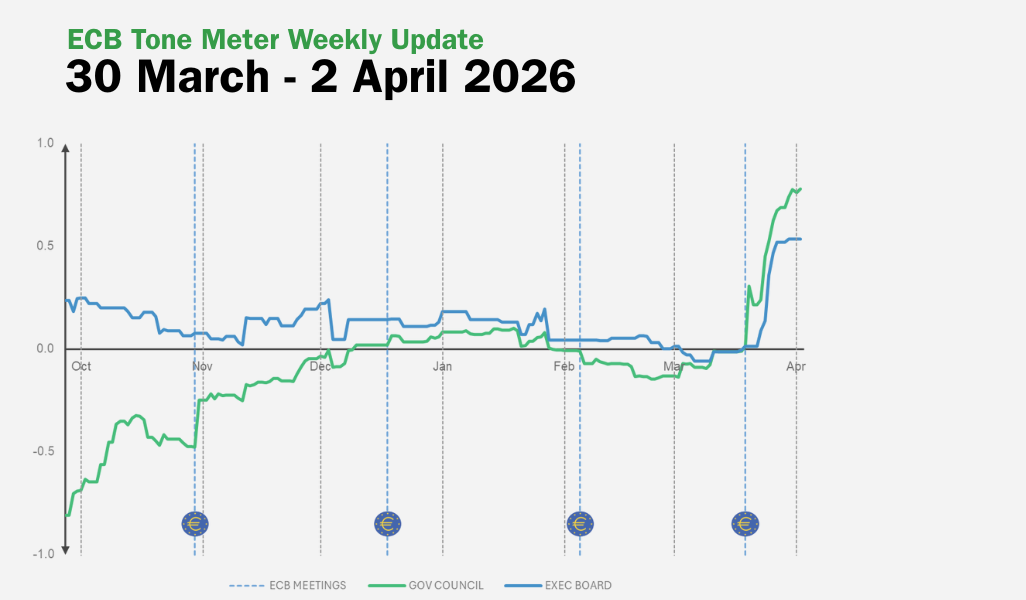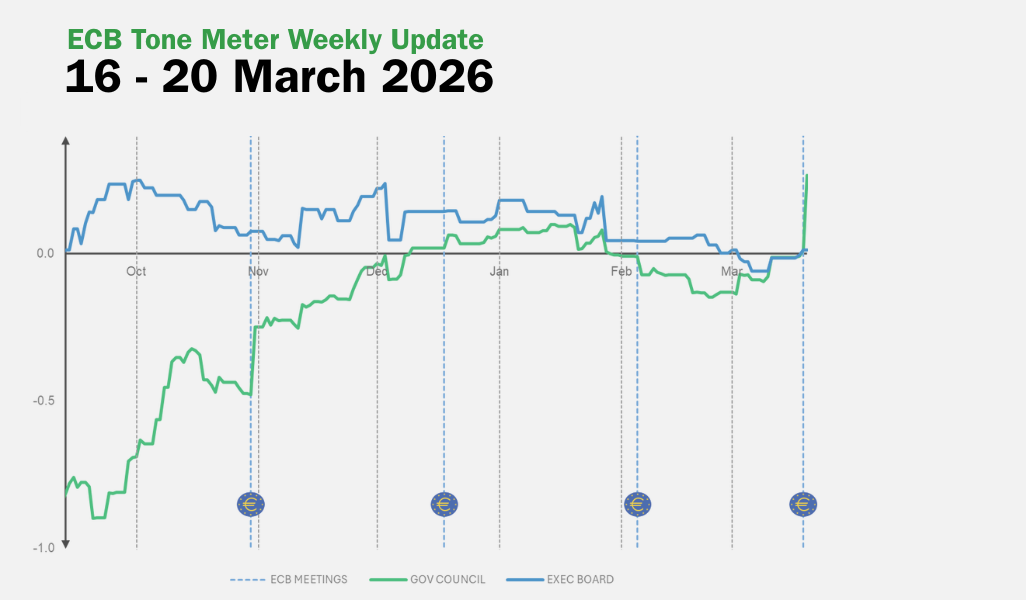
By Marta Vilar – MADRID (Econostream) – Econostream’s ECB Tone Meter showed a notable hawkish shift in the Governing Council this week, with only a minimal shift in the same direction from the Executive Board.
The Governing Council index rose to +0.27 from -0.01, while the Executive Board index increased to +0.01 from -0.01. Following a quiet period ahead of the ECB’s press conference, several policymakers signaled support for a possible rate hike soon, with one even suggesting such a move, depending on developments, “would probably be necessary.”
Biggest Movers of the Week: Lagarde, Nagel, Villeroy and Escrivá
Despite increasingly aggressive market pricing for rate hikes, ECB President Christine Lagarde struck a broadly neutral tone at the press conference, refraining from offering forward guidance and reiterating only that the ECB would “do what is necessary.”
A mild hawkish nuance could be inferred from her reference to “a bit of propagation” in energy price increases, pointing to second-round effects on inflation. Still, her remarks led to only a slight upward shift in the ECB Tone Meter.
The more pronounced shift came on Friday from Deutsche Bundesbank President Joachim Nagel, who said a rate hike “would probably be necessary” if the inflation outlook deteriorated and inflation expectations rose—an outcome he described as “conceivable.” His comments were the most hawkish since the start of the Iran war of all Governing Council members' remarks.
Other policymakers, while using more measured language and avoiding explicit probabilities, also indicated that a move could come as early as April, including Latvijas Banka Governor Mārtiņš Kazāks.
However, more heavily weighted voices in the index, such as Banque de France Governor François Villeroy de Galhau and Banco de España Governor José Luis Escrivá, did not reinforce expectations of an imminent rate hike.
Villeroy noted that while a rate increase now appeared more likely than a cut, a scenario leading to lower rates could not be “totally” ruled out, though he acknowledged it was “obviously much less likely.”
Escrivá, for his part, suggested that shocks of this kind can sometimes dissipate without requiring policy action. His remarks, along with those of his French counterpart, were assessed as slightly dovish and helped offset the more hawkish tone from others.
Dominant Themes in this Week’s Communication: Readiness to Consider Action in April
With the March meeting concluded, policymakers’ communication this week—limited to Friday due to the quiet period—focused on the possibility of adjusting rates at the next monetary policy meeting on 30 April.
Nagel said more “reliable data” on whether the outlook is worsening, and inflation expectations are rising—conditions he linked to a hike—could be available as soon as April.
Central Bank of Ireland Governor Gabriel Makhlouf said the ECB would “absolutely take action” if incoming data by 30 April warranted it, adding that the meeting was “definitely” live.
Kazāks likewise pointed to April as the earliest point at which the ECB could “assess what needs to be done on the monetary policy side.”