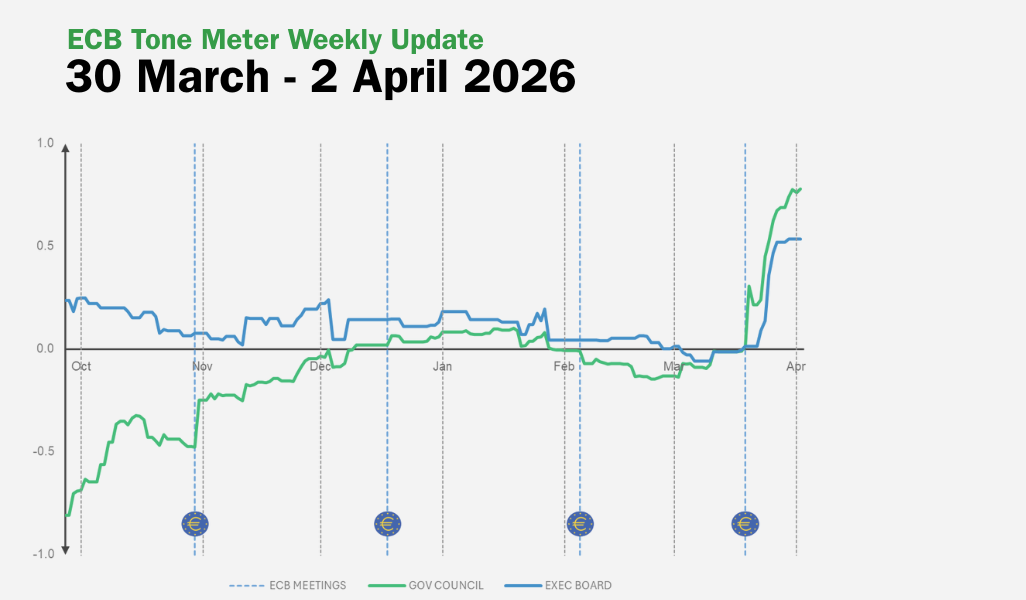
By David Barwick – FRANKFURT (Econostream) – When it comes to interest rates, the very likely outcome of this week’s meeting of the European Central Bank’s Governing Council is another hold. Policymakers’ harder task will again be communication: President Christine Lagarde will want to acknowledge that the Iran war has heightened upside inflation risks, without letting markets infer that a near-term rate hike has effectively become the new baseline.
The central question is not whether tighter policy could ever be required. Plainly, it could—potentially as soon as April, if events evolve badly enough in the interim, even without a full projection exercise that month. That is not our base case, but it is a genuine possibility.
The more immediate question is how far Lagarde wants to encourage markets to think a hike has become the likelier next move. The longer the conflict drags on and energy prices stay elevated, the stronger the case becomes that the next move, when it comes, will be up rather than down.
Still, our view as of today is that she will stop short of offering such encouragement explicitly, even while making clear that the Council is now on materially higher alert amid more threatening upside risks.
As the conflict emerged, the ECB’s public framework was still one of patience rather than reflex. Chief Economist Philip Lane said on March 3 that higher energy prices would push up inflation in the near term and hurt activity, but stressed that the policy-relevant question was whether the shock would prove broad and durable enough to alter the medium-term outlook.
More revealing was Executive Board member Isabel Schnabel’s March 6 speech in New York, which she largely repeated on March 11 in Frankfurt, after further turmoil on energy markets. Monetary policy remained “in a good place,” she said, adding that policymakers had to watch the persistence of the energy shock, its effect on inflation expectations and any sign of pass-through by firms.
That is the language of someone arguing against a reflexive policy response, and it has defined the broader Governing Council line. Lagarde herself said on March 10 that the ECB would not “rush into a decision” because uncertainty and volatility were too high, and she suggested that the ECB was still assessing alternative outcomes rather than moving toward a policy response.
Banque de France Governor François Villeroy de Galhau and Bundesbank President Joachim Nagel struck essentially the same note on March 11, coupling calm with clear warnings that the ECB would not tolerate entrenched inflation.
For all that, it would be wrong to pretend nothing has shifted. Eesti Pank Governor Madis Müller was simply stating the obvious when he said on March 10 that the chance that the next move is a hike has increased.
Latvijas Banka Governor Mārtiņš Kazāks and Nagel have both explicitly linked a rate increase to the danger that a geopolitical energy shock could start lifting inflation expectations or feeding through more broadly into medium-term price dynamics.
The bottom line is that the Council is not signaling an imminent hike, but it is no longer speaking as though renewed tightening belongs only to the realm of theory.
That is why Lagarde is likely to separate scenario logic from signal logic next Thursday. She may well concede that in sufficiently adverse scenarios tighter policy would be required. But the ECB’s meeting-by-meeting, data-dependent approach is likely to remain at the center of its communication despite the shock. Meeting-by-meeting wins the day again.
What she will therefore probably avoid saying is that the odds now point to a hike as the ECB’s next move, because that would amount to directional guidance. That was already clear last October, for example, when she refused to reduce future choices to a neat cut-versus-hike probability statement.
If anything, there may be more room for a dovish surprise than for a hawkish one. The hawkish elements of Lagarde’s message are not hard to foresee: insistence on doing what is needed to preserve price stability, a declaration of high alert, acknowledgment of more threatening upside risks and perhaps even a refusal to rule out action at any meeting, with or without new forecasts. As noted, she may also concede that certain scenarios could require tighter policy.
But that same framework argues against anything more directional than that. It points instead to a refusal to indicate imminent action, to suggest an intent to act or to validate any particular market pricing.
Any apparent “dovishness” would be the mirror image of recent press conferences at which Lagarde was read as hawkish because she refused to validate a residual easing bias.
None of this should be mistaken for complacency. The Council will clearly want to avoid two opposite errors at once: rushing into a response to a shock that may yet fade, and being late if persistence starts to emerge.
In that sense, 2022 still hangs over the discussion even as policymakers insist that this shock is different from the post-Ukraine inflation surge. Today’s officials keep stressing the narrower energy focus of the shock (though food prices could also become more directly affected), the absence of the old reopening dynamics, growth that remains positive rather than recessionary, and inflation expectations that are still anchored.
That also has implications for the wording Lagarde may choose. We have long argued that the “good place” mantra has outlived its usefulness, and find it odd that Lagarde last month, after two consecutive press conferences without proactively invoking it, spontaneously resuscitated the phrase.
If she proactively deloys “good place” on Thursday, which we doubt, it cannot sound like a synonym for comfort. More likely, it would be presented as a position from which the ECB can move quickly if required. She may prefer the more functional phrasing she used in February, when she said policy was in “good shape” because it was “agile,” data-dependent and not tied to a predetermined rate path.
The more interesting implication may therefore concern April rather than March. If, by then, the ongoing conflict has crossed whatever threshold is needed for policymakers to judge the shock persistent, and if inflation expectations or pass-through dynamics start to look problematic, the lack of a fresh full projection round should not be seen as an iron bar to action.
That inference follows naturally from the ECB’s own insistence that policy is set meeting by meeting, without pre-commitment, and from the fact that public comments now frame the issue around persistence and expectations rather than around calendar mechanics.
Our expectation is thus that Lagarde will recognize the direction of the risk shift, but not validate the market’s enthusiasm for rate hikes. She is likely to say that upside inflation risks have become more salient because of energy, that the Council is watching expectations and pass-through extremely closely, and that it stands ready to act if medium-term price stability is threatened.
But the longer the war continues, the greater the risk to that view. For now, she will probably stop short of saying outright that the next move is now more likely to be up. For an ECB that wants maximum optionality under maximum uncertainty, that would still be a step too far.