
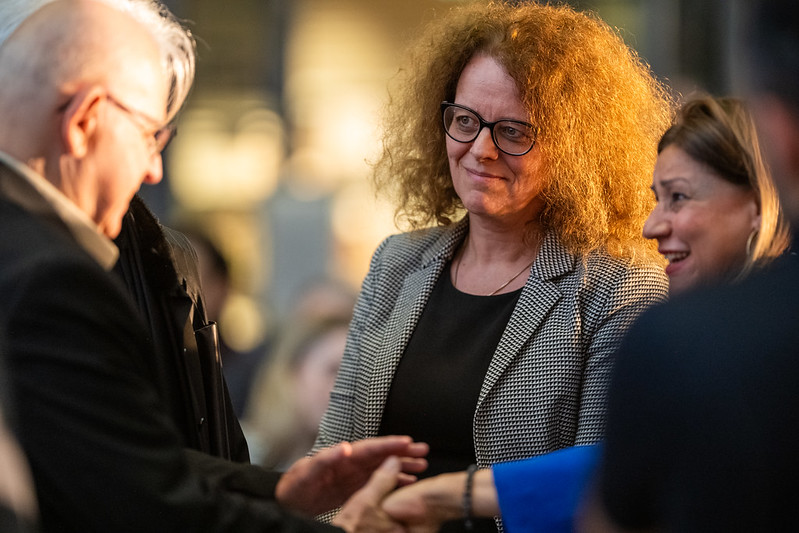
By David Barwick – NEW YORK (Econostream) – European Central Bank Executive Board member Isabel Schnabel on Friday said that the shock from the escalation of the Middle East conflict would be more concerning if it proved to be relatively lasting.
During the Q&A follower her speech at the 2026 US Monetary Policy Forum in New York, Schnabel said of the energy price shock due to the war in Iran that while “dramatic” on the face of it, “if you take a longer term perspective…it’s rather small.”
“Of course, if it turns out to be more persistent, we would be more worried,” she said.
As it stands, “we have to look very carefully” at relevant variables in gauging the potential need to modify the ECB’s policy stance in response to the shock, she said. These included inflation expectations, she said—less market-based, but rather “especially of households and firms.”
As well, evidence of “any kind of pass-through” would be key going forward, she indicated. “These are the type of variables that we are going to look at very carefully,” she said.
Schnabel insisted that despite the doubts of some market participants (“Some say, ‘Well, but are you really that symmetric?”), she could assure observers that the ECB understands its mandate in a “fully symmetric” way.
This implies that just as the ECB was willing to look through the “slight undershoot” of its inflation target, she said, “of course the same has to be true in the opposite direction.”
“Of course, if there is an energy price shock, it’s unavoidable that in the short term you have deviations from target,” she said. “There’s nothing that monetary policy can do about it.”
Monetary policy can however ensure that it does not come to a wage-price spiral, she said.
“We learned our lesson from the pandemic,” she said. “It’s important to stress that the lesson is not that we can never look through” deviations from target. “Even if the Philips curve is flat, inflation may come back very quickly, and we just need to look at the right things to see whether that is happening or not.”
Regarding goods price inflation, Schnabel said, “Of course we have been discussing this a lot, and the impact that China has and so on.”
“Part of” the low inflation of this type “is coming from China,” she said, “but it’s not so much this issue of trade diversion. This is something that we haven’t really seen.”
The idea of China being unable to sell its products to the US and diverting them to European markets instead “hasn’t really happened,” she argued. Rather, the changes were more a “structural” shift “that has been ongoing for quite some time.”
In other comments, Schnabel said of AI that “the impact on r* is very likely to be positive. But again, we need to see.”