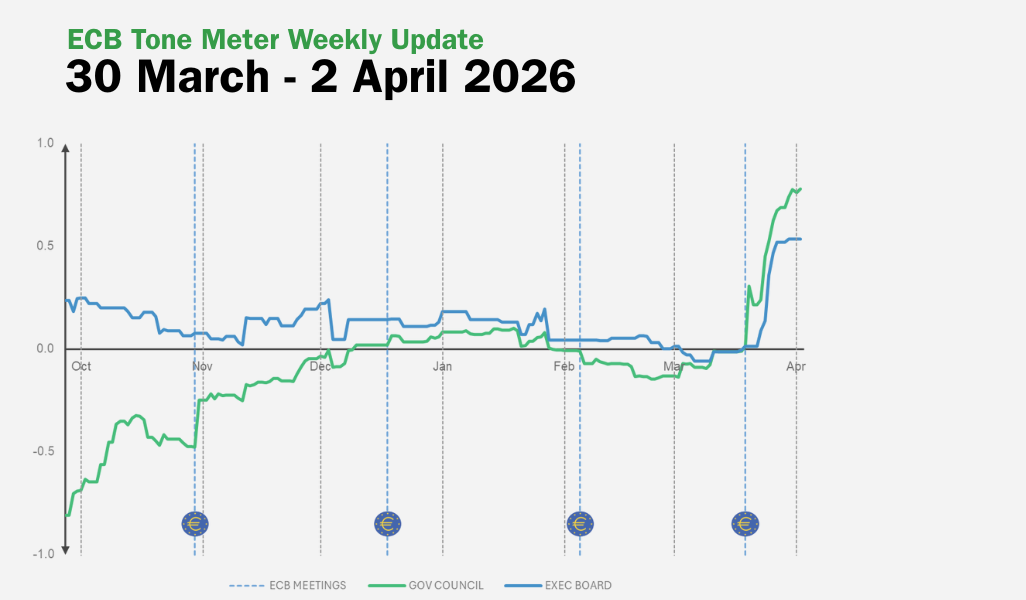
By David Barwick and Marta Vilar – FRANKFURT (Econostream) – From today’s still-early perspective, the conflict in the Middle East looks much more likely to stiffen the European Central Bank’s caution at its March meeting than to trigger any immediate policy adjustment.
Not that the shock is minor, but it is simply too fresh, too fluid, and too difficult to map into a reliable medium-term inflation outlook for policymakers to want to lurch in response.
That basic point is coming through with remarkable consistency. Banque de France Governor François Villeroy de Galhau said on Tuesday that “it would be a mistake to rush into predicting a possible change in interest rates today,” while his Greek counterpart Yannis Stournaras said the Governing Council “should not rush” and must “show flexibility,” explicitly stressing that the effect on inflation and output depends on the “duration and the depth” of the conflict.
Central Bank of Ireland Governor Gabriel Makhlouf called it “far, far too early to come to conclusions,” and Belgian National Bank Governor Pierre Wunsch said the ECB should not “rush” to react to an energy-price spike but should first “assess” the situation.
Austrian National Bank Governor Martin Kocher made essentially the same point in more analytical language, warning against pre-empting uncertain outcomes and emphasizing the option value of acting only if the risks actually materialize.
Another voice reinforcing that message is Mārtiņš Kazāks, who told Reuters on Tuesday that there was “no need to rush” the ECB’s next move and that the Governing Council should effectively sit tight until there is more clarity about the conflict’s consequences.
Notably, he framed the shock as creating “opposing forces,” suggesting that the policy significance of the event cannot be inferred mechanically from the initial energy-price move alone. That formulation is useful because it captures why an immediate March reaction looks unlikely.
On one side are the obvious inflationary risks from energy and supply disruption; on the other are the negative implications for activity and the possibility that the shock tightens conditions in ways that work against demand.
Kazāks also called the current level of rates “appropriate” and said scenario analyses on the conflict could be part of the March meeting. That combination — no need to rush, rates appropriate for now, and scenarios needed to map the balance of forces — points much more toward watchfulness than toward imminent action.
Finally but importantly, Philip Lane was no less cautious. In the two questions added to Tuesday’s Financial Times interview after the latest escalation of the conflict, the ECB’s chief economist did not sound like someone preparing the ground for a near-term policy reaction.
He repeated the familiar diagnosis: directionally, higher energy prices would push up inflation in the near term and weigh on activity, but the scale of the effect and the implications for medium-term inflation would depend on the breadth and duration of the conflict. That is to say, the shock is real, but not yet interpretable.
That is also why the comparison some are making with 2022, when Russian dictator Vladimir Putin launched a war of aggression against Ukraine, is not very persuasive. As one Governing Council member told Econostream on background, the ECB is in “a completely different place” now.
Back then, inflation was already surging and policy was plainly behind the curve. Today, by contrast, rates are widely seen inside the Governing Council as around neutral, and the institution is not being forced to decide whether to begin a belated normalization campaign in the face of an inflation outbreak.
The same official also suggested that the broader market response to the conflict could complicate the inflation picture. But even that only reinforces the main point: this is not a situation in which the ECB can assume that a higher oil price mechanically dictates a monetary response.
The outgoing Villeroy’s caution is, of course, not entirely disinterested, given his instincts have typically run in a more dovish direction. A supply shock that works against that preference naturally incentivizes preaching against overreaction.
Still, the caution is much broader than that. Doves, centrists and hawks alike are converging on the same practical conclusion: in March, the bar for changing rates in response to this conflict is very high, as of today.
The more plausible channel through which the conflict affects the upcoming meeting is therefore communication, not the rate decision itself. If the conflict still looks entrenched by 18-19 March, it should become harder for President Christine Lagarde to sound as comfortable as before about the ECB’s position.
The current line — that the ECB is in a good place and can proceed meeting by meeting — should survive only in a darker register, if at all. The emphasis is likely to shift more heavily toward uncertainty, vigilance, optionality and the two-sided nature of the risks.
The projections complicate matters further. If recent March patterns are any guide, the technical assumptions feeding into the staff forecasts were probably locked some time ago, before the latest escalation.
That means the baseline may show only a limited inflation effect from the conflict, not because staff view the shock as trivial, but because the cutoff may simply have come too early to capture more than a sliver of it. In that case, the projections would risk understating the immediate energy impulse and would be of only limited use in judging the broader consequences.
That points directly to a likely workaround: scenario analysis. Lane himself noted this week that an escalation in the Middle East has long been among the ECB’s tracked risk scenarios, and he referred to the December 2023 Eurosystem staff exercise showing a substantial energy-driven inflation spike and a sharp drop in output in the event of a persistent supply disruption and broader regional disruption.
If the March baseline is partly stale on this issue, the natural way for the ECB to address the shock will be to supplement it with scenarios rather than to pretend the baseline already has the matter covered.
The early conclusion is therefore hardly that the Middle East conflict is irrelevant for the ECB, but rather that for now, it is more likely to harden caution than to force action. A quick rate adjustment to a shock whose persistence, transmission and net effect still cannot be sensibly assessed is improbable.
A meaningful change in tone is another matter entirely. If the conflict persists, March may turn out to be the meeting at which policy stays put while the language becomes materially less comfortable.