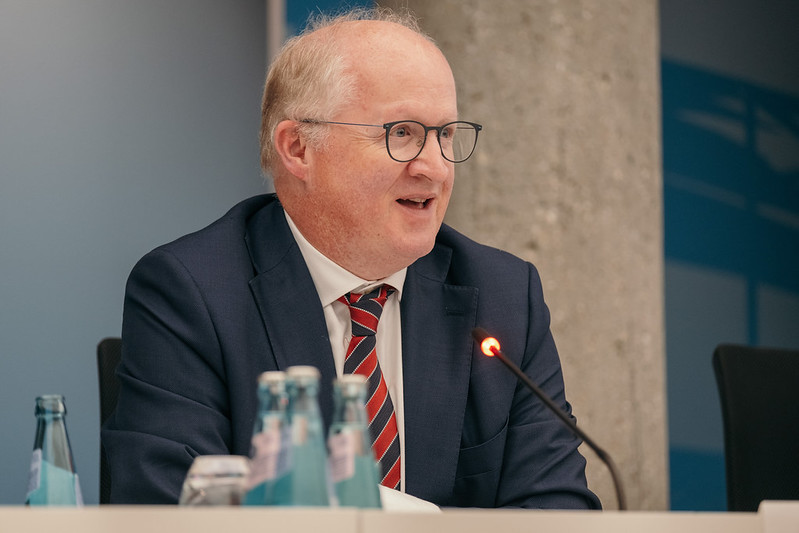
By David Barwick – FRANKFURT (Econostream) – European Central Bank Executive Board member Philip Lane on Tuesday warned that a potential escalation of military conflict in the Gulf could deliver an energy-price-driven inflation shock while weighing on euro-area growth, stressing that the magnitude and the implications for the medium-term inflation outlook would depend on the breadth and duration of any disruption.
“Directionally, a jump in energy prices puts upward pressure on inflation, especially in the near term, and such a conflict would be negative for economic activity,” Lane said in an interview with the Financial Times, adding that the ECB would be “closely monitoring developments.”
Lane said an escalation in the Middle East has long been one of the ECB’s main risk scenarios, pointing to a Eurosystem staff scenario analysis published in December 2023 that found a conflict could trigger “a substantial spike in energy-driven inflation and a sharp drop in output” if it caused a persistent drop in energy supplies and disrupted regional activity.
“The impact would be amplified if it also gave rise to a repricing of risk in financial markets,” he said.
Outside that risk scenario, Lane said the euro-area economy is expanding “in the neighbourhood of its potential.”
Business investment has exceeded expectations and is the main factor behind stronger-than-anticipated growth, he said, citing artificial intelligence and the green transition as drivers of capital upgrading. Consumption and government spending are contributing broadly as expected, while exports remain “essentially a drag.”
In 2023 and 2024, growth was below potential, leaving “still spare capacity, particularly in manufacturing,” he said, adding that the economy is “near potential but not clearly above it.”
On prices, Lane said he sees underlying pressures easing toward target.
“When I look at the inflation forecast, I see non-energy inflation converging to the target, from above this year,” he said, describing that as “a good projection,” especially since inflation “is not expected to settle below our target.”
Recent headline softness partly reflects “mild energy deflation,” he said, with energy inflation expected to move from slightly negative to “a little bit positive,” including due to the new EU emissions trading system (ETS2) in 2028. Wage growth is expected to decelerate further this year, while food inflation may remain somewhat above headline, he said.
Symmetry and the Policy Stance
Lane reiterated that the ECB’s reaction function is symmetric around the 2% target.
“We are symmetric in caring about deviations above or below 2%,” he said, explaining that policymakers assess the origin and persistence of any deviation as well as implications for expectations before responding.
However, he cautioned that inflation dynamics may differ depending on the direction of the shock, noting that to the upside “we could get non-linear dynamics, as inflation might overshoot.”
Asked why projected quarters of modest below-target inflation do not justify further rate cuts, Lane pointed to the current macroeconomic configuration.
“The economy is currently growing in the neighbourhood of its potential. Non-energy inflation is still converging from above 2%, and there was some upside surprise in compensation per employee in the autumn,” he said.
“This is not an environment where I see an argument in favour of taking a bit of risk on inflation,” he said. “I think where we are now is okay.”
He also rejected comparisons with the early phase of the previous inflation surge, arguing that the present undershoot is small in scale and that pass-through from modest energy price declines is limited.
“[A]t this point in time, we shouldn’t be pre-emptively saying the shortfall is so big, let’s cut in response,” he said.