
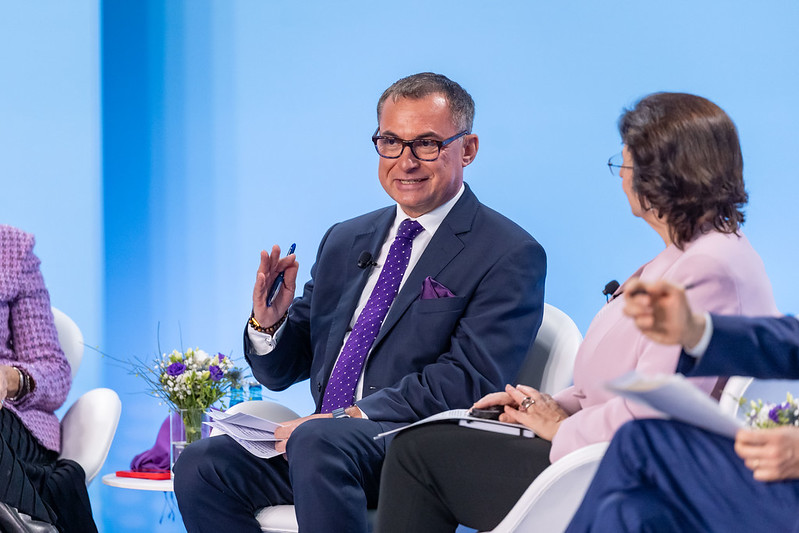
By David Barwick – FRANKFURT (Econostream) – European Central Bank Governing Council member Joachim Nagel said on Sunday that the ECB was “in a good position” at current interest rate levels and should continue setting policy meeting by meeting as trade and geopolitical uncertainty remain high.
Nagel, who heads the Deutsche Bundesbank, said in a speech in Baden-Baden that policymakers had done well to keep their options open and “stand ready to adjust our monetary policy stance in any direction whenever it becomes necessary.”
The inflation picture in the euro area was “favorable overall,” he said, with price developments remaining consistent with the ECB’s medium-term 2% target.
According to Nagel, the December Eurosystem projections imply a “temporary slight undershooting” of 2% this year and next before a “point landing” at 2% in 2028, though he cautioned that the outlook remained “highly uncertain.”
On the economy, Nagel said the Bundesbank expected German growth of about 0.6% this year and 1.3% next year in calendar-adjusted terms, with additional government spending on defense and infrastructure providing a significant lift.
He also said the euro-area economy had proved more resilient than expected over the past year, “despite the appreciation of the euro,” while December Eurosystem projections foresaw growth of 1.2% this year and 1.4% in 2027 on a calendar-adjusted basis.
A volatile trade environment was one reason for caution, he said. Referring to the shift in US trade policy since President Donald Trump took office, Nagel said the effects on euro-area growth and inflation of the latest tariff changes were “likely to remain limited.”
Still, he warned against complacency about the outlook. “[W]ho knows whether tariffs will be in place after 150 days, and if so, at what level?” he said.
Nagel also said rising doubts about the US dollar’s safe-haven status had helped weaken the currency, adding that the euro’s appreciation against the dollar and other currencies mattered for both growth and inflation in the euro area.
On financial stability, he said risks tied to German banks’ lending business were increasing and warned that sound capitalization should not lead observers to overestimate banks’ resilience in the current environment.
Beyond monetary policy, Nagel argued that Europe needed to respond to the changed global environment by deepening its internal market, strengthening critical industries, and finally making the Savings and Investment Union a reality.
He also renewed his call for a digital euro, saying Europe’s dependence on non-European payment providers was costly and left it exposed strategically. “Digital payment services are not a ‘nice-to-have’, but rather basic necessities, similar to gas and clean water,” he said.
Nagel said he hoped the legislative process for the digital euro would be completed this year so that it could become reality by 2029, while also pointing to work on a wholesale central bank digital currency for large-value financial transactions.