
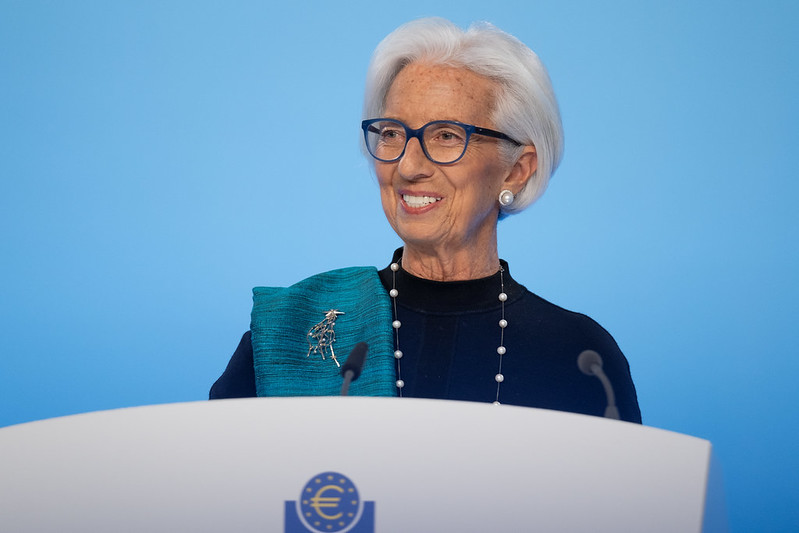
By David Barwick – FRANKFURT (Econostream) – European Central Bank President Christine Lagarde on Monday used a Washington speech to defend the ECB’s policy independence and crisis-response speed while arguing that Europe is moving toward a more domestic-demand-led growth model that could support stronger long-term expansion.
Speaking at the National Association for Business Economics conference while accepting the Paul A. Volcker Lifetime Achievement Award, Lagarde tied her institutional argument to current policy debates by praising central-bank resolve and warning that legal protections alone were insufficient.
“Independence ultimately has to live in the culture and conviction of the people who serve these institutions – because sooner or later, the legal limits will be tested,” she said, after citing Paul Volcker’s anti-inflation tightening and saying Federal Reserve Chair Jay Powell had upheld the same tradition.
She then pushed back against the idea that Europe’s institutional complexity necessarily means slow or indecisive policymaking, presenting the ECB’s Governing Council size as a strength rather than a handicap.
“One might expect a structure of this size to result in inertia. In practice, it gives us distinctive strengths,” Lagarde said, adding that decisions drawn from 27 perspectives were “harder to reach,” but also harder for any single government to influence.
On monetary policy specifically, she argued that diversity had not prevented rapid action in crises and pointed to the ECB’s recent record on both tightening and easing.
“When inflation surged, we raised rates by 450bp in a little over a year, the fastest tightening cycle in the ECB’s history. We then cut them again by 200bp as inflation stabilized at our medium-term target,” she said.
Beyond the policy-institutional defense, the speech’s main economic message was that Europe’s old reliance on foreign demand had become less viable amid tariffs and global trade tensions, especially with the United States and China playing a more difficult external role for euro area exporters.
Lagarde said Eurosystem staff expected exports over the next three years to grow at roughly half their historical average pace, while investment needs at home were rising and making domestic demand more central to growth.
She said euro area growth reached 1.5% in 2025, “its strongest performance in three years, despite rising trade tensions,” and added that the expansion was driven entirely by domestic demand, with net exports subtracting half a percentage point.
In a currency- and external-balance-relevant section, Lagarde said the euro area’s current account surplus had fallen to 1.6% of GDP in 2025 from 2.7% in 2024 and was projected to remain around that level, describing this as part of a more balanced relationship with trading partners.
She also highlighted euro area capital flowing abroad, noting that residents’ holdings of listed US equities had become comparable in share to their domestic listed-equity holdings and saying euro area investors earned nearly €200 billion from those US holdings in 2025.
At the same time, she argued that redirecting more European savings into domestic investment could generate larger gains at home through productivity and innovation, especially as defense, infrastructure, digitalization and AI-related spending rose.
According to Lagarde, investment is projected to account for almost 40% of euro area growth between 2026 and 2028, well above historical norms, with more than €150 billion in additional cumulative investment.
She also presented a relatively constructive view of Europe’s supply-side potential, saying firms were adopting AI tools rapidly and suggesting Europe’s manufacturing base could become an advantage as AI is embedded in industrial systems.
Investor sentiment toward Europe, in her telling, had improved sharply as well, and she pointed to a rise in AI-related venture-capital deals and stronger appetite among institutional investors to increase allocations to Europe.
Still, Lagarde said stronger demand and improving private-sector momentum would not translate automatically into durable growth without policy changes, especially in the Single Market and capital markets.
She argued that internal barriers in services and capital markets were the most damaging constraints and cited ECB analysis suggesting that lowering internal barriers could raise intra-European trade substantially, with GDP effects far larger than estimated losses from US tariffs.
Another key obstacle, she said, was the large share of household wealth parked in deposits, contrasting Europe’s more than €12 trillion in cash and deposits with a much lower US share and suggesting that aligning portfolio structures could redirect major sums into long-term market-based investment.
Lagarde pointed to what she described as more flexible EU methods for moving forward, including the proposed “28th regime,” recent use of mechanisms allowing subsets of countries to advance, and a June deadline set by EU leaders for the first phase of the savings and investments union.
Her closing message was that Europe was increasingly able to act on structural weaknesses even outside acute crises, and she ended on an explicitly confident note.
“The same dynamic can apply again. And my message today is: it will,” she said.
Lagarde did not use the speech to send any near-term signals regarding ECB monetary policy, instead referring to the institution’s past tightening-and-easing cycle to illustrate its independence and operational capacity.