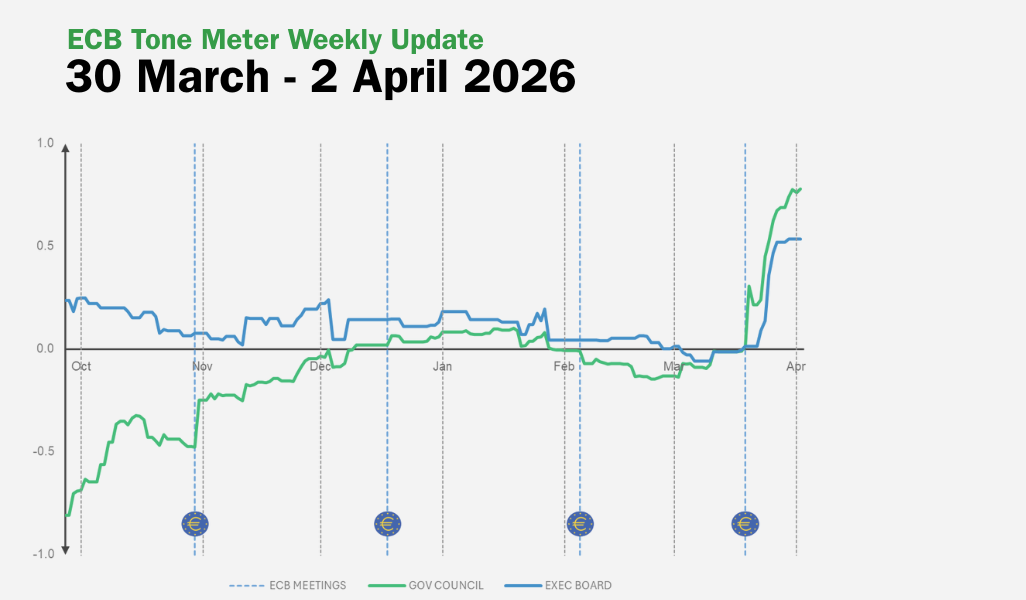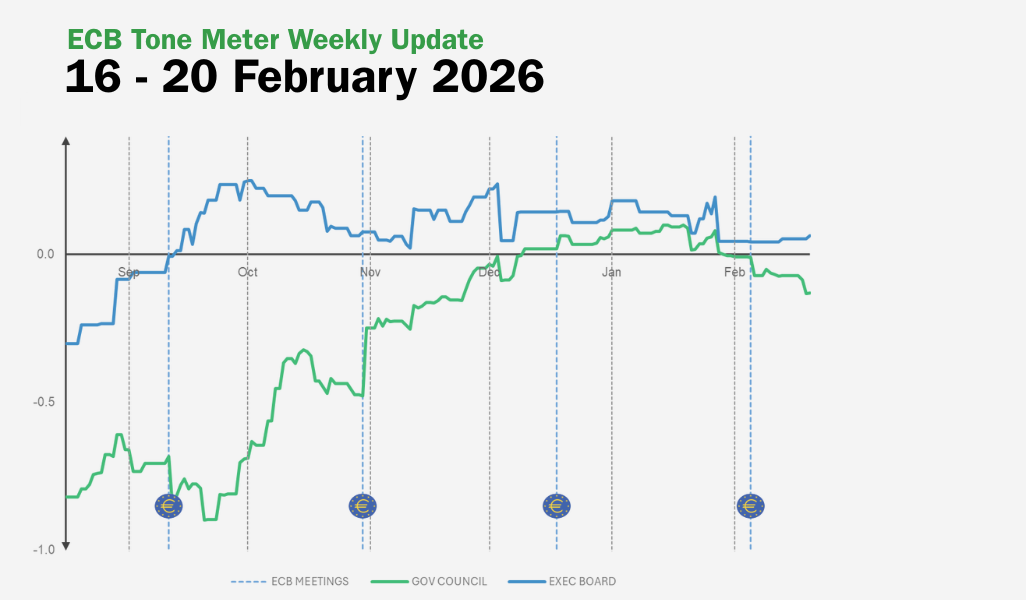
By Marta Vilar – MADRID (Econostream) Econostream’s ECB Tone Meter showed the Governing Council turning marginally dovish this week, while the Executive Board was little changed and remained mildly hawkish.
The Governing Council reading slipped to -0.13 from -0.07 the previous week, while the Executive Board measure inched slightly higher to +0.06 from +0.05. Overall, communication adopted a somewhat more dovish tone, with some Governing Council members explicitly introducing the possibility that the next move could be a rate cut.
Biggest Movers of the Week: Stournaras and Villeroy
Among the Council’s most prominent doves, Banque de France Governor François Villeroy reinforced his dovish assessment of inflation risks this week. On Wednesday, he said downside risks were “greater” than upside risks and that he was “convinced” of this.
As we noted in an Insight, this represents a shift from just eight days earlier, when he described downside risks as only “a little stronger” than those on the upside.
Some governors went even further, explicitly mentioning the possibility of a “rate cut” and suggesting the next move was more likely to be downward than upward. Bank of Greece Governor Yannis Stournaras was among them.
He said there was now a “slightly higher” probability that the ECB’s next step would be a cut rather than a hike — a noticeably more dovish stance than on 6 February, when he described risks as balanced and saw no need to adjust rates.
In an interview with Econostream, Central Bank of Malta Governor Alexander Demarco also presented a risk assessment that leaned modestly to the downside, as detailed in our Insight. He likewise introduced the possibility that a rate cut could eventually “become necessary.”
Dominant Themes in this Week’s Communication: A Revival of the Rate Cut Debate
Discussion of further rate cuts resurfaced this week, despite efforts by most Governing Council members to keep options open and avoid signaling a clear directional bias.
While Villeroy was particularly explicit in highlighting the predominance of downside risks, ECB Vice President Luis de Guindos struck a more measured tone, describing risks to growth as broadly balanced but emphasizing those on the downside. Meanwhile, Stournaras and Demarco brought the rate cut debate more directly back into focus.
Although neither of the two made an outright call for easing, both indicated that the next move could be a rate cut — a stance that goes further than that of the majority of the Council.