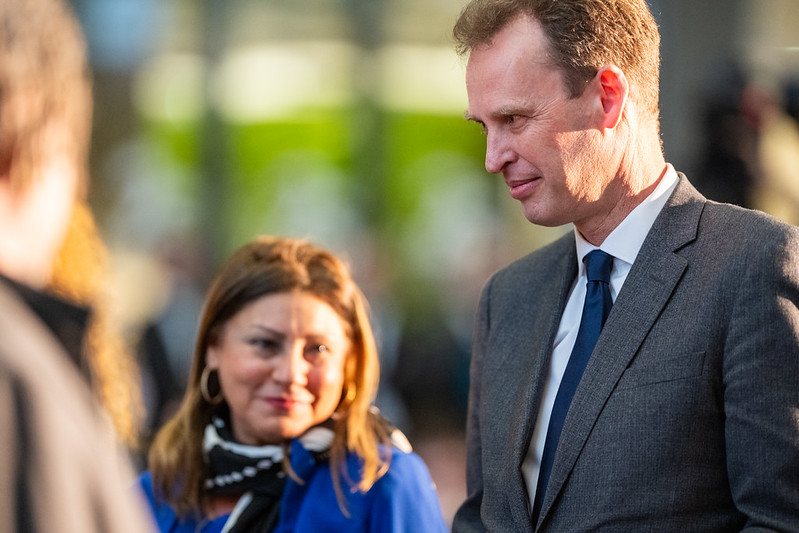
By David Barwick – FRANKFURT (Econostream) – European Central Bank Executive Board member Frank Elderson on Thursday said most banks under ECB supervision have now built the capacity to manage climate- and nature-related risks, after supervisors escalated pressure in steps that largely avoided periodic penalty payments.
Elderson, who is vice chair of the ECB’s Supervisory Board, told Bloomberg in an interview that only two of 110 supervised banks required periodic penalty payments as supervisors enforced climate-related milestones, with 32 formal decisions issued across three “waves.”
Supervisors set an end-2024 deadline with interim milestones after concluding banks were moving “but we wanted them to move faster,” he said, adding that proportionate escalation “works” and has driven additional investment and staffing as more than 90% of banks now deem the risks material.
On broader bank criticism that supervisors produced too many findings to prioritize, Elderson said this was “to a certain extent” fair, and pointed in the context of the Supervisory Review and Evaluation Process to a revised “two-tier system” that classifies findings, with F3 and F4 treated as most material while F1 and F2 are not actively pursued.
On data aggregation and reporting, he said progress was insufficient at “too many banks,” and that supervisors would keep climbing the escalation ladder, with periodic penalty payments “neither imminent nor excluded.”
Elderson also argued against deregulation, saying this was “not the time to deregulate,” while framing simplification as process-focused, including shorter, more targeted on-site inspections and reports and less “one size fits all.”
On market topics, he said some synthetic risk-transfer structures carry rollover and other risks but declined to speculate on limits, calling it “too early,” while urging a quick resolution on Europe’s implementation path for the Fundamental Review of the Trading Book to provide clarity and preserve a level playing field.
Turning to European integration, he called for completing banking union and capital markets union, and said supervisors were neutral on cross-border consolidation so long as legal criteria are met.