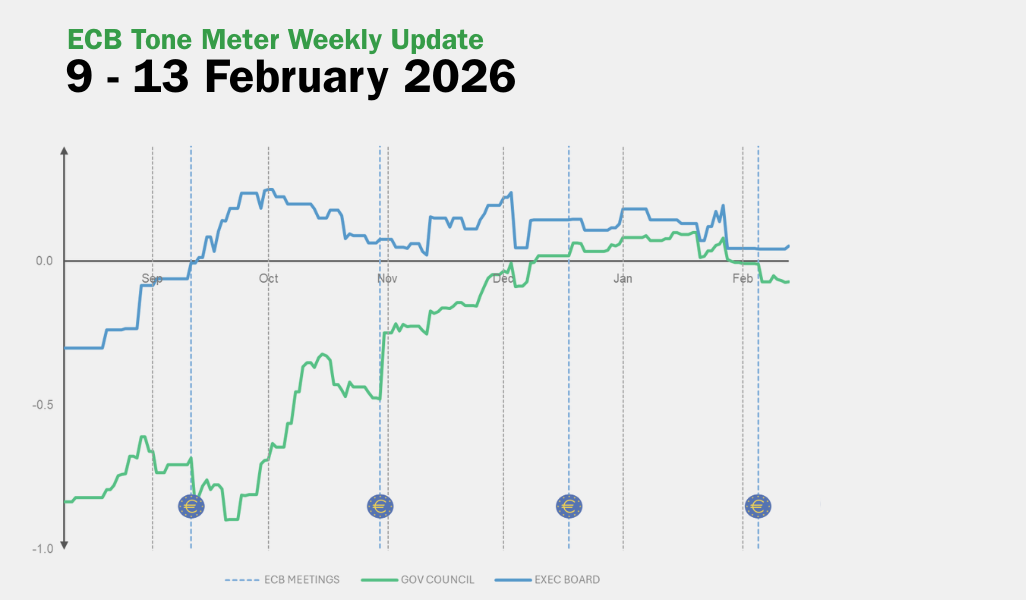
By Marta Vilar – MADRID (Econostream) – Econostream’s ECB Tone Meter showed the Governing Council and the Executive Board remained broadly stable this week, with only a marginal hawkish shift in each that is unlikely to be materially significant.
The Governing Council reading ticked up marginally to -0.07 from -0.08 the previous week, while the Executive Board measure inched slightly higher to +0.05 from +0.04. Comments spanned both sides of the spectrum, resulting in a broadly neutral impact on the index.
Biggest Movers of the Week: Nagel, de Guindos and Villeroy
One of the most notable tone shifts this week came from Deutsche Bundesbank President Joachim Nagel. In a detailed speech, he set out the case for why the ECB should refrain from responding if inflation were to fall below 2% in the coming quarters. He described the probability of such an undershoot as “quantitatively small”, attributing it largely to volatility in energy prices. This downplaying of near-term undershooting risks warranted a more hawkish assessment.
However, this shift was partially moderated by not-so-hawkish remarks later in the week. On that occasion, he refrained from elaborating on how the ECB should react to a potential deviation from target and characterized incoming German data as “good news”, adding that he expected further positive developments.
ECB Vice President Luis de Guindos also made relevant comments this week in an interview with Econostream. While he described risks as balanced overall, his focus primarily on two downside risks and his emphasis on concerns related to Chinese imports supported scoring him for the second week in a row as just barely dovish.
Banque de France Governor François Villeroy’s remarks this week struck a more dovish tone than previously. His assessment of risks was also framed more emphatically: he said downside risks were “a little stronger” than upside risks, whereas last time he had described them as “probably more significant” than the latter.
Dominant Themes in this Week’s Communication: Exchange Rate
Although the ECB has sought to dispel the notion that recent exchange rate moves would prompt any form of policy response, policymakers have continued to address the issue.
For the most part, their remarks were aimed at conveying vigilance without alarm. Latvijas Bank Governor Mārtiņš Kazāks made this distinction explicit, describing the ECB’s stance as a “manifestation of attention” rather than “verbal intervention.” He went somewhat further than most, however, noting that the full effects of the euro’s appreciation have yet to materialize.
Asked by Econostream about the exchange rate, de Guindos swiftly downplayed its capacity to alter the ECB’s trajectory, calling it “not dramatic.” Nagel likewise said the euro’s recent strengthening was “unlikely to materially change” the outlook embedded in the December 2025 projections, which he noted had been broadly reaffirmed at the February meeting.