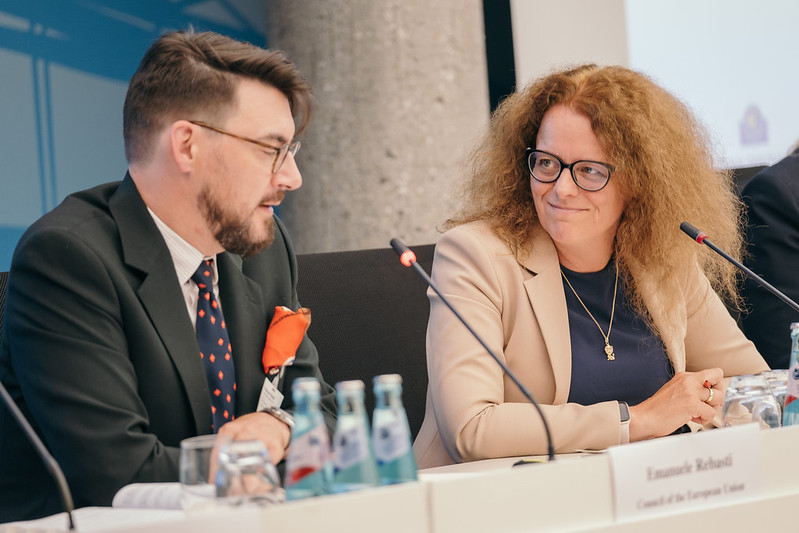
By David Barwick – VIENNA (Econostream) – European Central Bank (ECB) Executive Board member Isabel Schnabel on Wednesday argued that portrayals of Europe as a continent in decline are “misleading,” and urged policymakers to unlock the Single Market’s potential to give European firms the scale they need to compete globally.
In a lecture hosted by the Austrian Academy of Sciences, Schnabel expanded on the ideas expressed in her Financial Times op-ed earlier in the day and said Europe’s core problem was not a shortage of talent or ideas, but rather insufficient scale, which she said could be addressed by creating a “28th regime” for companies operating across the European Union.
Schnabel cited quality-of-life metrics to rebut what she described as a simplistic decline narrative, pointing to strong social protection, accessible public infrastructure, and education systems that support opportunity and mobility.
She also contrasted health outcomes in Europe and the United States, saying that life expectancy in countries such as Spain and Italy exceeded that in the United States by more than five years despite higher US health spending.
On measured income gaps, Schnabel argued that standard GDP-per-capita comparisons overstated differences in living standards because Europeans work fewer hours and have more generous leisure-time and social arrangements.
She said that, on average, an employee in the United States worked about 40 days more per year than an employee in the euro area, and that a simple counterfactual suggested euro area real GDP per capita would be 21% higher if Europeans worked as many hours as Americans, holding productivity per hour and employment rates constant.
Schnabel also emphasized distributional differences, saying the top 10% of earners in the United States accounted for around 37% of national income after taxes, compared with about 27% in the euro area.
At the same time, she said sustaining Europe’s social model required stronger growth, warning that weak productivity growth in the euro area threatened longer-term improvements in living standards.
Turning to intra-euro area divergences, Schnabel said the underperformance narrative “does not hold up in large parts of the currency union,” pointing to the southern euro area as an example of improved investment, falling unemployment, and more favorable financing conditions relative to Germany.
She argued that the euro area’s “traditional core” now faced more acute headwinds, highlighting Germany’s extended period of subdued growth and saying the country’s export-driven business model was “no longer viable” in a fragmenting world because of a sustained weakness in domestic demand.
Schnabel said Germany was taking steps to address this imbalance, hailing what she called the largest fiscal impulse “since the Second World War” as “a welcome step in the right direction,” provided higher spending was allocated wisely and accompanied by structural reforms.
She said targeted public investment—alongside support for the green and digital transitions and measures to strengthen Germany’s defense capacity—could bolster demand while lifting the supply side, and argued that “[h]igher public spending, if allocated wisely and accompanied by structural reforms, boosts potential growth and crowds in private investment.”
The broader European challenge was a scale problem, she said, with regulatory and administrative barriers still obstructing the free movement of services and goods.
“These internal barriers are estimated to be equivalent to tariffs of 96% for services and 67% for goods,” she said. “Some industries, such as food production and construction, face even greater hurdles.”
She presented a “28th regime” as the most powerful way to cut fragmentation, describing it as a unified European corporate framework—open to firms of all sizes and sectors—that would allow companies to incorporate as genuinely European firms, referencing European Commission President Ursula von der Leyen’s “EU Inc.” concept.
Under her proposal, Schnabel said incorporation would be quick, cheap, and fully digital, with a unified rule set covering core elements of company law, governance, shareholder rights, and employee financial compensation, while leaving labor markets, social security systems, and corporate taxation to member states.
“A 28th regime would be a true game changer,” Schnabel said. “By giving firms seamless access to the entire European market, it would provide the scale needed to convert innovation into economic growth. It would allow Europe to compete as one economy rather than 27, and help create something Europe has long been missing: a true ‘Made in Europe’ brand.”