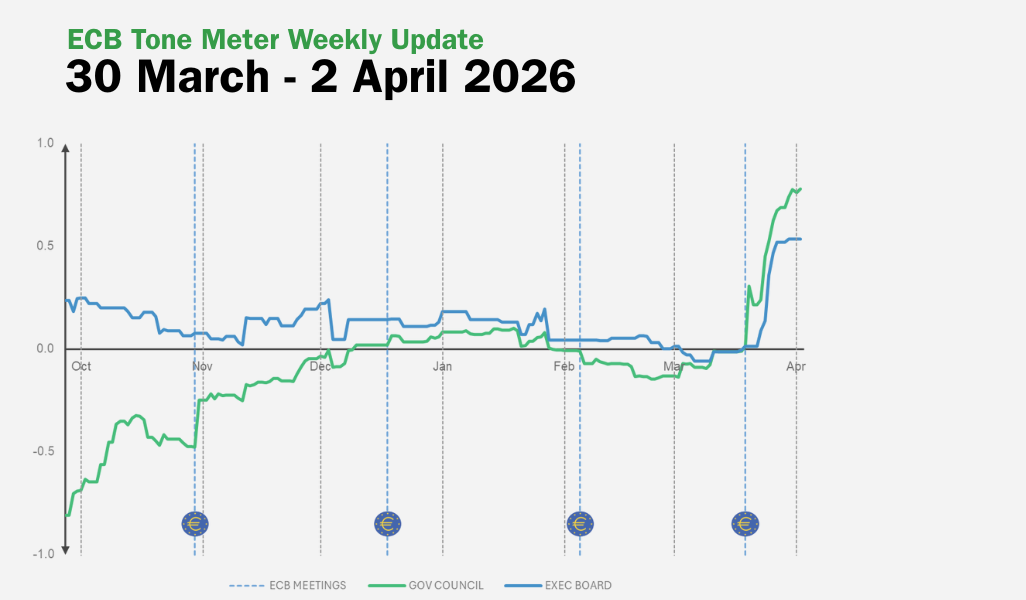
By David Barwick – FRANKFURT (Econostream) – The European Central Bank’s December meeting delivered what pre-meeting signaling had engineered: a unanimous hold, a reaffirmation of the “good place” mantra, and an explicit refusal to validate any market narrative about the direction of the next move — despite projections and rhetoric that look more consistent with a tightening bias than with renewed easing.
The key outcome was not the rate decision itself, which had been fully baked in, but the communications choreography around an upgraded macro profile and an inflation path that still undershoots in the middle of the horizon.
Lagarde’s solution was to let optionality and uncertainty do much of the heavy lifting: “good place” reconfirmed, but “not static”; unanimity on holding today, and unanimity that “all optionalities should remain on the table”; and, critically, a blunt insistence that there was “no” discussion of hikes or cuts.
In one stroke, the Council tried to prevent a better forecast narrative from hardening into de facto guidance.
The new projections did the awkward work for her. The salient change is not the late-horizon convergence of inflation to target, but the admission in the statement that 2026 inflation has been revised up “mainly because staff now expect services inflation to decline more slowly.” That is as close as the ECB comes, in a formal document, to telling markets that the remaining inflation problem is the sticky one.
At the same time, the growth story is simply stronger. The statement frames this as a domestic-demand story, and Lagarde went further at the press conference, portraying an economy whose “surprises on the upside” are “characteristically investment,” including private-sector investment, which she linked explicitly to AI.
She also highlighted an upside surprise from exports — initially expected to reflect inventory build-up and tariff frontloading, but now described as “sustainable,” with a notable chemicals-sector and Irish contribution.
This matters because it changes the narrative texture of the plateau. A hold that is merely a bridge is one thing; a hold atop an improving, investment-led expansion is another. If the economy is shifting toward higher investment and stronger potential, the symmetry of risks around 2% becomes harder to maintain in practice — not because inflation is re-accelerating, but because the “restrictiveness” of 2% becomes more contestable over time as growth and confidence improve and as financial conditions threaten to ease endogenously.
Yet the ECB still has to sell patience without sounding complacent, and has to acknowledge the macro upgrade without inviting markets to pull forward hikes. Lagarde’s answer was to treat uncertainty as the institutional alibi for discretion.
In her clearest pushback against the idea that Executive Board member Isabel Schnabel’s “next move is a hike” comment should be read as quasi-guidance, she argued that while activity and the 2026 inflation projection have moved up, uncertainty “if anything may have actually worsened,” spanning geopolitics, trade diversion from “countries with overcapacity,” and border-related developments. With uncertainty elevated, she said, the ECB “simply cannot offer forward guidance.”
This is the new equilibrium of ECB communication: the forecast becomes more constructive, the rhetoric becomes less tolerant of services persistence, and the policy stance becomes more plausibly the conditional terminal rate — but the institution refuses to let that reality crystallize into a rate-path narrative.
The inflation discussion itself contained a subtle tightening of emphasis. Services inflation is described as rising to 3.5% in November, and wage dynamics are treated with greater granularity than in some recent communications: compensation per employee at 4.0% is flagged as above what September projections assumed, driven by payments beyond negotiated wages.
At the same time, Lagarde and the statement offer reassurance via forward-looking indicators — wage tracker and surveys — pointing to easing and stabilization somewhat below 3% by late 2026. In other words, the ECB is telling markets: yes, the sticky part is sticky; no, we do not yet see a wage regime that forces our hand.
On the undershoot in 2026-27, the Council delivered the look-through framework almost exactly as pre-positioned. Inflation is expected to be below 2% on average in those years, with energy inflation negative over much of the period and inflation excluding energy gradually declining.
The return to 2% in 2028 is framed as partly an “upward effect” from ETS2, now assumed to start then rather than 2027. The operational message is: undershoot is tolerable noise if expectations remain anchored; the late-horizon convergence is intact; and the ETS2 shift is timing mechanics, not a reason to react today.
That is why “good place” survives — for now. But the way Lagarde defended it (“not static”) and wrapped it in optionality suggests the phrase is being asked to do heavier work than before.
When “good place” entered the ECB’s vocabulary, it functioned as a shorthand for two-sided readiness in a still-easing-biased environment. Now it must describe a posture of conditional persistence while markets increasingly treat the easing tail as a stress contingency rather than a baseline alternative.
This is exactly where the communications risk lies: keep saying “good place,” and it begins to sound like coded inertia; change it too abruptly, and markets hear a green light for tightening expectations.
Today, she chose continuity with guardrails. The guardrails were explicit: no rate path, no set date, optionalities remain, and uncertainty blocks forward guidance. Implicitly, she also chose to let the market continue doing some of her work by pricing out near-term easing and keeping the center of gravity at a stable plateau without forcing the ECB to endorse a hiking bias.
The risk assessment reinforced this balancing act. Growth risks are presented as two-sided: disruptions and financial tightening on one side; defense and infrastructure spending, reforms, and confidence on the other.
Inflation risks are also framed as unusually uncertain and two-sided, with trade diversion and a stronger euro as downside channels, and supply-chain fragmentation, wages/services persistence, and fiscal spending as upside channels.
The list reads like a deliberate refusal to declare an asymmetry, even as the projection revisions and the services/wage emphasis quietly nudge the audience toward thinking the next policy surprise, if any, is more likely to be on the tightening side.
One telling detail: the Q&A was conspicuously dominated by topics with limited immediate market relevance — Executive Board succession, stablecoins, Russian assets, the digital euro. In a sense, that is a verdict on the ECB’s own pre-meeting signaling success: when rates are a foregone conclusion and the president refuses to discuss the next move, the press conference becomes an institutional stage for strategic themes rather than a pricing catalyst.
The bottom line is that the Council validated a better growth narrative, conceded a stickier services profile via the 2026 inflation revision, and reaffirmed a medium-term inflation path that still includes early-horizon undershooting — and then used uncertainty to keep the policy distribution deliberately unfixed.
Markets should take from this what they already suspected: 2% is not merely “appropriate,” it is increasingly the conditional terminal rate; cuts require a shock; and while hikes are not imminent, the ECB is working hard not to rule them out.
Lagarde already used “good place” more sparingly today, hinting at message fatigue; if the growth upgrade proves durable into March, the phrase is more likely to be replaced than repeated. Indeed, we do not exclude its retirement at the February meeting.
For now, the ECB ended 2025 by refusing to turn an improving narrative into guidance, and by insisting that discretion itself is the stance.