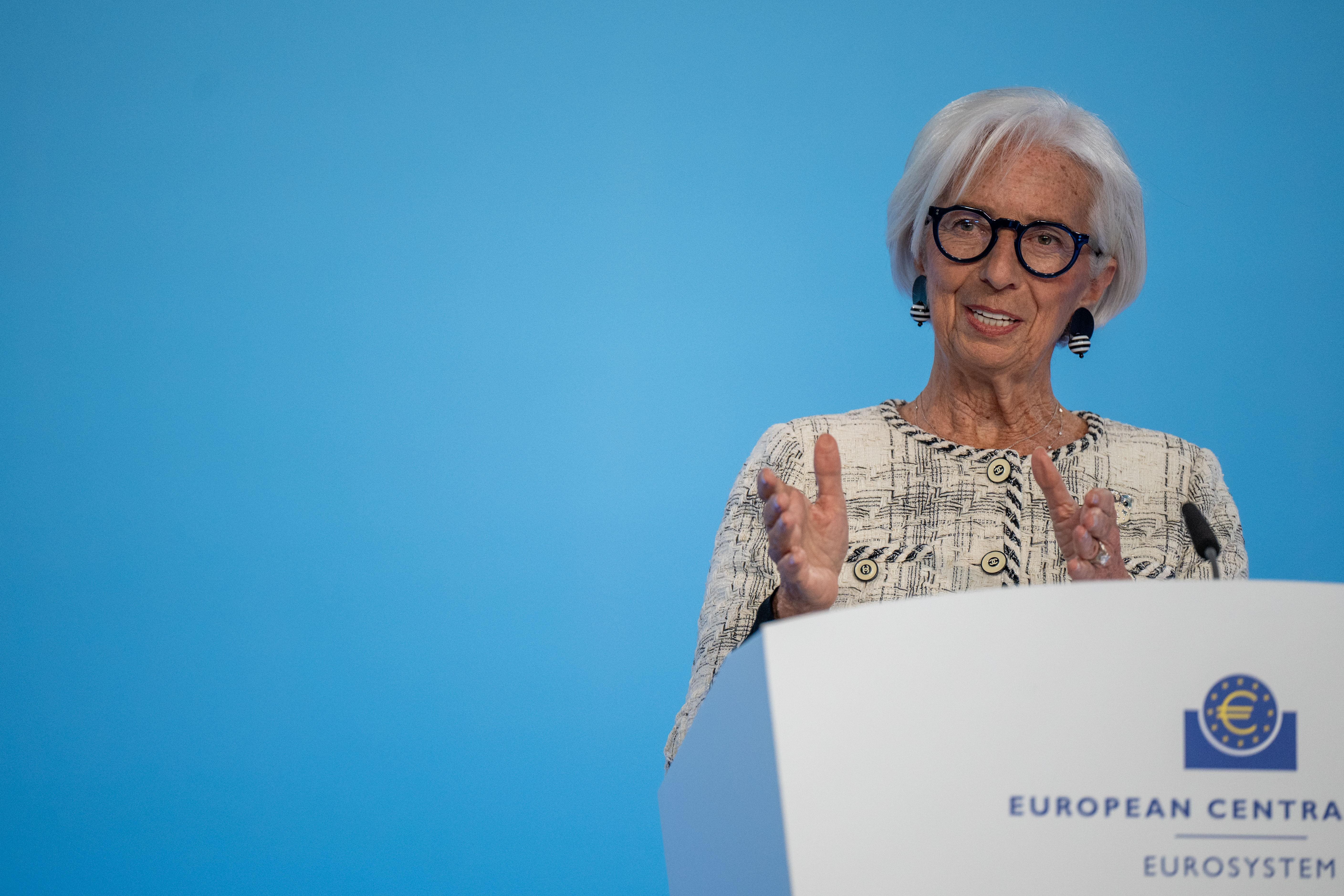
By David Barwick – FRANKFURT (Econostream) – European Central Bank Executive Board member Isabel Schnabel’s latest intervention does not mark a new “turn” so much as the clearest consolidation of a line she has been following for months: small, forecast-based undershoots of 2% can be tolerated, while the real dangers still run to the upside.
The Bloomberg interview published Monday essentially stitches together the themes of her interview five months ago with us and her subsequent (largely duplicative) remarks to Reuters in August and applies them to the December projection round: rates are “in a good place”; the bar for further easing is very high; and a symmetric 2% target does not mean treating every decimal point the same way.
On growth, Schnabel repeats the resilience story: robust domestic demand, supportive fiscal policy, strong labor markets and an AI-linked investment pickup are enough to push the euro area to growth “above potential” despite tariff headwinds.
That alone does not change policy, but it underpins her abiding sense that the macro environment is not fragile enough to justify further accommodation on risk management grounds.
On inflation, she continues to draw a sharp distinction between headline and underlying. Headline is “in a good place” around 2%, with ETS2 and energy base effects set to introduce noise and even brief dips below target.
What matters, she insists, is the medium term, and here the message is notably less relaxed: the decline in core has stalled; services inflation “still stands well above the pre-pandemic average”; wage dynamics remain stronger than expected; and food inflation keeps household expectations elevated.
The result is an explicit verdict: “all in all, inflation is in a good place, but risks to inflation are tilted to the upside.” That is almost exactly the balance she has been describing since early summer; Monday’s interview simply states it more crisply.
The most sensitive passages, in the current context, concern what to do with projected undershooting in 2026-28. Schnabel leans hard on the strategy’s tolerance for moderate deviations, as long as they do not become “sustained” in the expectations channel. For her, what matters is not the mechanical point estimate for 2028, but the underlying narrative—why inflation is below target and whether the deviation could persist.
She makes that operational in the clearest way yet: asked directly whether a below-2% path in 2026 and 2027, partly due to an ETS2 delay, would worry her, she replies that, assuming the deviations were small, she “would not be concerned in the current macroeconomic environment.”
The fact that she folds ETS2 into the list of temporary, level-type distortions allows her to bracket both the timing change of implementation and any small undershoot as tolerable noise, not a reason to reopen the easing debate.
In that sense, Schnabel provides the operational backbone for the broader Governing Council effort to downplay 2028: the projections remain “just an input” — as Central Bank of Ireland Governor Gabriel Makhlouf has put it — and small shortfalls can be ignored as long as expectations stay anchored and the broader narrative is benign.
Symmetry is respected in theory – “moderate deviations from target” can be tolerated in either direction – but the practical threshold for acting on a downside miss is set very high.
We are strongly reminded of ECB Chief Economist Philip Lane’s speech last week; the contrast is instructive. Lane reasserted the full symmetry framework, warning that multi-year baseline misses cannot be dismissed as “small” simply because they arise partly from relative-price shocks.
Schnabel’s line is narrower and more operational: she treats ETS2 and other timing-related distortions as level effects that can be ring-fenced, and she puts more weight on the macro narrative than on the last-digit precision of the projected inflation path.
In effect, Lane defends the doctrine; Schnabel translates it into a practical tolerance for mild undershooting when the broader risks point upward.
Her discussion of the policy path reinforces that asymmetry. “Interest rates are in a good place,” she says, and “in the absence of larger shocks” she expects them to stay there “for some time.”
With risks now tilted to the upside, both markets and survey participants expect the next move to be a hike, and she is “rather comfortable with those expectations.” The timing of that move is deliberately vague – she refuses to endorse any particular date – but the direction of travel is not.
Two further elements help explain why she sees the bias that way.
First, Schnabel again raises the possibility that the natural rate of interest has risen, citing AI and public investment. If r* is higher, an unchanged policy rate becomes more accommodative over time unless inflation falls in parallel.
That logic turns the “hold” into a form of gradual easing by inaction, and she explicitly warns that, if the stance drifts too far in that direction, that “would then be a time to think about another rate move” – i.e. a hike, not a cut.
Second, she remains deeply skeptical that downside risks to expectations are relevant after the recent inflation episode. Food prices are still salient, household expectations are higher than a year ago, and in earlier interviews she has made clear that she sees the probability of a genuine downward de-anchoring as “highly unlikely.”
In that world, the practical risk she worries about is overshooting from an overly loose stance, not a slide into too-low inflation.
On the external side, Schnabel maintains the standard independence line on the Fed. A more aggressive US easing path under a new chair would work through the exchange rate and global rates, but the ECB will “run our monetary policy independently, based on our own data and our own analysis.” Any disinflationary impulse imported from the dollar side would simply be folded into the projections like any other shock; it is not a reason, in itself, to reopen cuts.
Put together, Monday’s interview does not contradict Schnabel’s past messaging; it tightens it. She remains a cautious, medium-term-oriented policymaker who rejects both autopilot and fine-tuning, insists on a very high bar for reacting to small forecast misses, and treats the symmetry clause as compatible with tolerating mild undershooting when upside risks dominate.
What has changed is not her framework, but the background against which it is now being applied. With the economy proving more resilient, core inflation stickier than hoped and fiscal policy turning more supportive, her long-standing reluctance to cut again now translates into an endorsement of the market narrative that the next move will be an eventual hike, and that a modest 2028 undershoot, on its own, is nowhere near enough to alter that trajectory.