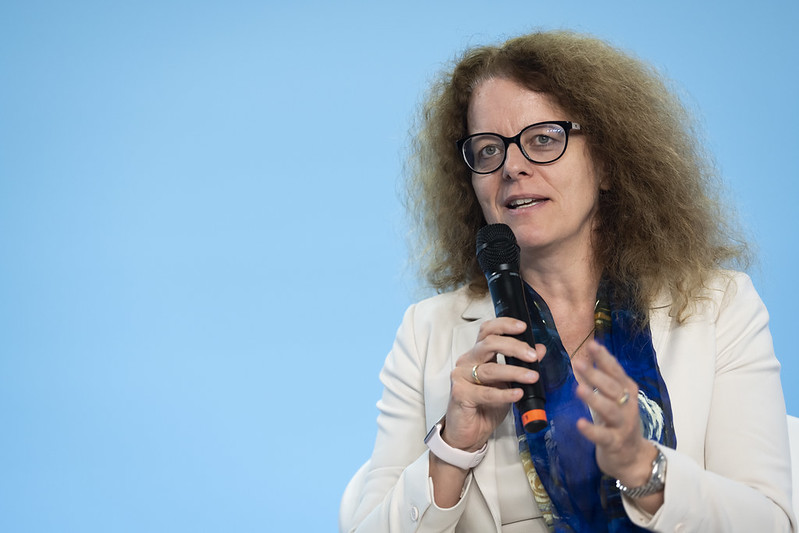
By David Barwick – FRANKFURT (Econostream) – European Central Bank Executive Board member Isabel Schnabel on Monday said interest rates were “in a good place” and likely to stay unchanged “for some time,” adding that markets and survey participants now expected the ECB’s next move to be a hike.
In an interview with Bloomberg, Schnabel said she was “rather comfortable with those expectations,” while stressing that the timing of any increase remained uncertain and was not a current focus for the Governing Council.
A rise in the natural rate of interest was plausible given developments in AI and public investment, Schnabel said. If r* were rising, maintaining the same policy rate could make the stance “more accommodative over time,” she said, which the ECB would need to monitor.
Inflation was around 2% and projected to remain close to target, she said. However, services inflation was “much stickier than expected,” driven by wage growth, demographic trends and slower-than-anticipated easing in compensation per employee.
She warned that the decline in core inflation had stalled as the economy recovered, the output gap closed and fiscal policy expanded. “Risks to inflation are tilted to the upside,” she said.
Growth prospects had improved, supported by domestic demand, a strong labor market and fiscal spending. A rapid decline in uncertainty had helped soften the impact of tariffs, she said, with global trade proving more resilient than expected.
Schnabel said divergence from expected U.S. monetary policy would not alter the ECB’s independence, though aggressive easing by the Federal Reserve would influence exchange rates and longer-term yields with global spillovers.
Quantitative normalization continued smoothly, she said, with excess liquidity still abundant and money market rates stable. Banks would turn more to ECB refinancing operations once liquidity declined sufficiently, a process that would occur endogenously, she said.
She said future structural liquidity should be supplied through a mix of structural refinancing operations and a structural bond portfolio. The portfolio would only be built once the remaining QE holdings had fallen substantially, she said.
Schnabel supported simplification of banking rules but rejected weakening capital requirements, saying the robustness of European banks through recent shocks showed that claims of reduced competitiveness were “a myth.”
Euro-denominated stablecoins could play a role in cross-border payments, though for domestic use “the digital euro will be dominant,” she said.
Asked whether she could be the German candidate for ECB president, she replied: “If I was asked, I would stand ready.”