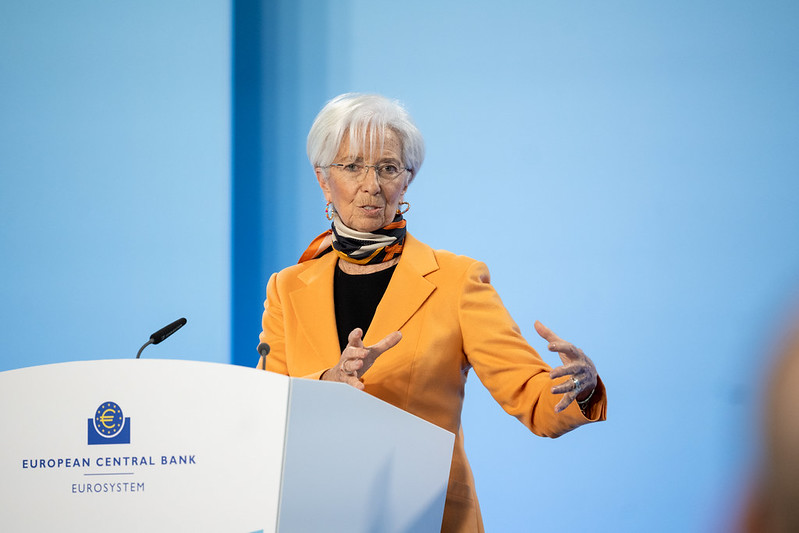
By David Barwick – FRANKFURT (Econostream) – European Central Bank President Christine Lagarde on Friday said the ECB would adjust policy as required to ensure inflation stays at its 2% goal, adding that the current easing in financing conditions is supporting demand.
“We have cut interest rates by 200bp from their peak, and this is increasingly feeding through into easier financing conditions, which is helpful to support demand,” she said in a speech at the 35th European Banking Congress. She reiterated that the ECB “will continue to adjust our policy as needed to ensure that inflation remains at our target.”
Domestic demand was set to become the main engine of euro area growth in the years ahead, helping offset external weakness, she said.
Europe’s long-standing export-led growth model had become a vulnerability, she warned. External trade had stalled, projections for export growth had been repeatedly downgraded and recent shocks had exposed the fragility of the model, she said.
Lagarde argued that rising US tariffs, the impact of geopolitical tensions and stronger competition from China had underscored the need for Europe to rely less on external demand.
She said the euro area’s persistent current account surplus had increased dependence on foreign markets, with European savings increasingly flowing to higher-return US equities, widening productivity gaps at home.
At the same time, she pointed to emerging risks from concentrated dependencies on key raw materials and technologies. “More than 80% of large euro area firms are no more than three intermediaries away from a Chinese rare earth supplier,” she said.
Lagarde said Europe’s domestic economy had nonetheless shown resilience, with employment growth closely tracking GDP since the pandemic.
“We have benefited from an unusually strong labour market – one that has remained remarkably resilient even as growth has slowed,” she said. “This strength has created a virtuous circle: rising employment has supported consumption, which in turn has sustained services output and created still more jobs – particularly in labor-intensive sectors.”
Intangible investment had remained robust as firms expanded spending on digitalisation and artificial intelligence, helping stabilise overall business investment despite manufacturing weakness.
She said fiscal policy had been countercyclical, with defence and infrastructure programmes particularly important for Europe. ECB staff estimate that higher government investment through 2027 will offset about one-third of the trade shock, she said.
Lagarde argued that Europe continues to leave significant internal-market gains untapped. ECB analysis shows internal barriers in goods and services markets equivalent to tariffs of roughly 65% and 100%, respectively, she said.
Progress in areas such as digital services, capital markets and taxation remained slow, with fragmentation preventing firms from scaling across the EU, she said.
To address this, Lagarde proposed reviving mutual recognition across key sectors, extending qualified-majority voting to unblock reforms and creating optional EU-level “28th regimes” that firms could adopt in place of navigating divergent national frameworks.
Such changes would help European companies expand cross-border, deepen the Single Market and strengthen Europe’s ability to finance innovation and growth, she said.
“If we make our Single Market truly single, Europe’s growth will no longer depend on the decisions of others, but on our own choices,” she said.