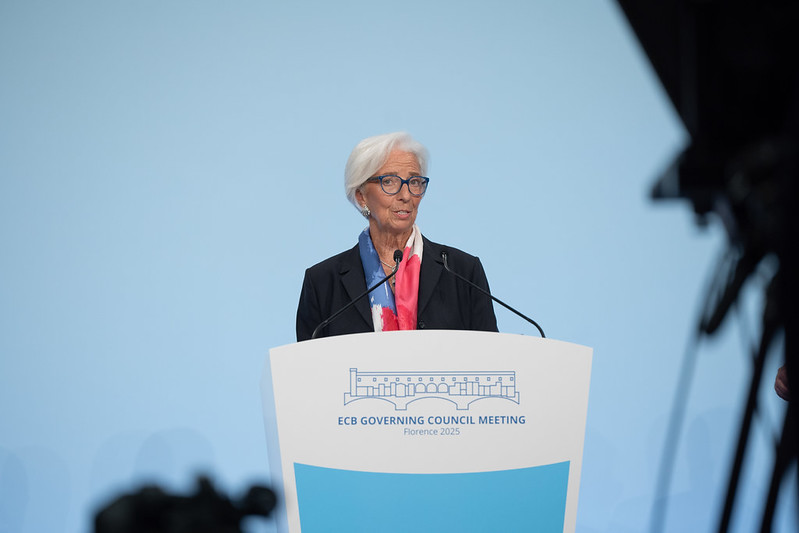
By Marta Vilar – FLORENCE, Italy (Econostream) – European Central Bank President Christine Lagarde said on Thursday that the ECB remained in a “good place”, but was again reluctant to declare it too durable.
In the press conference following the ECB Governing Council meeting in Florence, Italy, Lagarde said that “we are in a good place, but is it a fixed good place? No, but we will do whatever is needed to make sure we stay at a good place.”
She later dismissed suggestions that the repetition of this last phrase signaled deeper meaning, urging observers “not to overread.”
Lagarde pointed to Eurozone GDP data released earlier in the day, noting that the figures slightly exceeded both market expectations and the ECB’s own projections. “I would not complain too much about growth at this point in time,” she said.
Updating her September assessment that risks to growth were more balanced, Lagarde said that “some of the downside risks to growth have abated,” citing the EU-US trade agreement, the ceasefire in the Middle East, and progress in US-China trade negotiations.
However, she did not consider that this improvement extended to inflation risks. “I think on that front it's a more balanced picture that we paint, and we go through the upside and the downside risks to inflation and I would suggest that we remain attentive to the occurrence of any of these risks.”
Asked about the transmission of monetary policy and the tightening seen in the latest Bank Lending Survey, Lagarde said that “everything” led the ECB to think transmission was “effective” and “very much on time.”
The ECB was carefully monitoring wage growth and services inflation, she said, given their potential to impact underlying and domestic inflation.
Regarding the Emissions Trading System 2, she noted the European Commission still expected implementation in 2027 but hinted at a more gradual rollout.
For Lagarde, this meant that “the impact [of ETS 2] might be spread a little bit more in time, possibly a bit less in 2027 and a bit more in 2028,” she said, adding that the December projection exercise would incorporate this.
Related articles:
- ECB’s Lagarde: “Europe Is Resilient, but It Is Also Vulnerable”
- ECB’s Lagarde: Europe Must Unlock Investment to Build Renewables-Based Energy System
- ECB’s Lagarde: We’ll See Whether Dollar’s Attractiveness Erodes Further