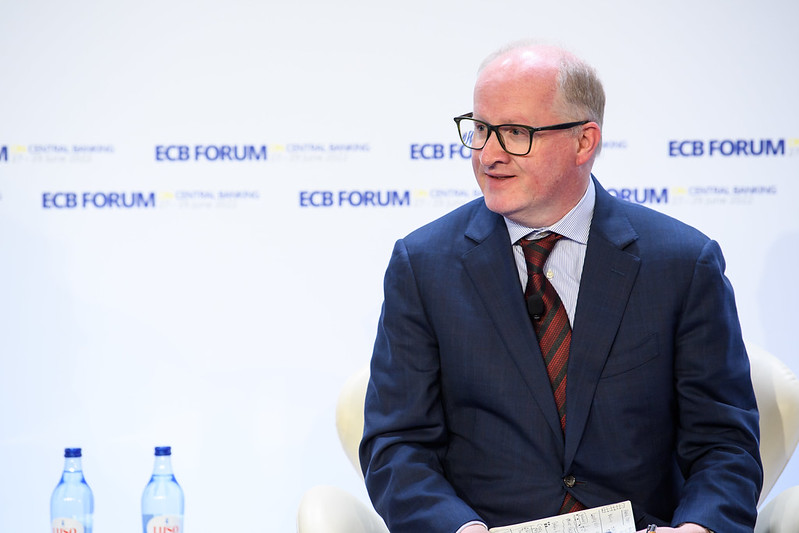
By David Barwick – FRANKFURT (Econostream) – European Central Bank Executive Board member Philip Lane on Tuesday said that there were factors arguing for a further decline in euro area inflation, but that there were also risks that could lead to the opposite result.
In an interview with German daily Frankfurter Allgemeine Zeitung, Lane said that ECB monetary policy had to find a middle ground, but that more easing was possible if there were indications that inflation would continue to subside.
‘We need to find a middle path’, he said. ‘If we keep interest rates too high for too long, the disinflation pressure of US tariffs could cause inflation rates to fall below our target. If we cut too much and too quickly, a strengthening economy and other factors could drive inflation back up.’
The ECB would therefore be closely observing the data in upcoming meetings, he said.
‘If we see signs of further falling inflation, we will respond with further interest rate cuts – but the range of discussion is not that wide: no one is talking about dramatic rate cuts’, he said. ‘We are in a zone of normal central banking.’
The task of restoring price stability had ‘mostly been completed’, with services inflation still too high but expected to come down, he said.
‘So the disinflation from the high inflation of 2022 is on track – but unfortunately new challenges are emerging’, he said.
Euro area inflation would stay ‘close to 2% in the coming months’, but the question of whether this was sustainable was not yet answerable, he said. In particular, tariffs ‘could cause an inflation issue in either direction’, he said.
Various factors such as the euro’s strength, slower global growth and the redirection to Europe of Chinese products could limit the inflationary impact of tariffs, he said.
‘But we also have to keep in mind that we don’t know the outcome of the negotiations between the EU and the United States’, he added.
For now, what the ultimate outcome would be was ‘still quite open’, though there were ‘some factors that tend to support a drop in euro area inflation’, he said.
This could change if trade talks failed and the US imposed higher tariffs with European retaliation, he said. Supply chain disruption could also create price pressures, he said.
The ECB was occupied chiefly with the medium term, over which tariffs could impact inflation, also via the exchange rate and energy prices, he said.
Taking the deposit facility rate into clearly accommodative territory below 1.5%, a number Lane said was ‘for the sake of discussion’, would need the justification of greater downside inflation risks or a clearer weakening of the economy, he said.
‘I do not see that at the moment’, he said.
The ECB, he said, was between such a territory and its opposite, a clearly restrictive stance, which he suggested could be close to or above 3%.