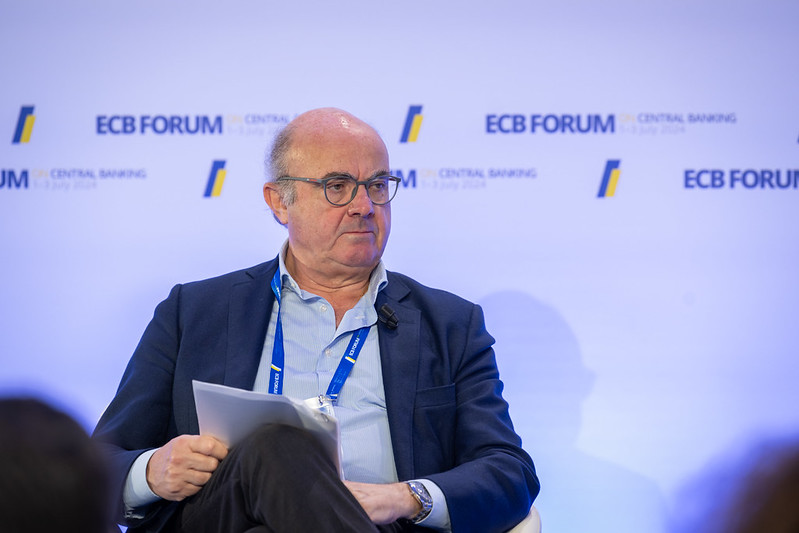
By David Barwick – FRANKFURT (Econostream) – European Central Bank Vice President Luis de Guindos on Tuesday said that tariffs could ultimately prove deflationary and that growth in the euro area was very weak.
During an on-stage conversation at the Comillas Investment Club of Universidad Pontificia Comillas in Madrid, de Guindos said that the introduction of tariffs by the US amounted to a ‘paradigm shift’ in terms of global economic governance and was the materialisation of a downside risk for growth.
Euro area economic growth was in any case ‘very low’, a ‘fundamental reason’ for which was persistently low household consumption, notwithstanding risen real incomes, he said.
This was because consumers under the current circumstances understandably increasingly lacked confidence, he said.
‘The risks are clearly to the downside’, he said.
A tariff was essentially a tax on imports and could even be deflationary in the end despite an initially inflationary impact, he said. Services inflation was decelerating, he said.
The situation was also characterised by risks to financial stability, he said, citing high asset prices, sovereign debt strains and the susceptibility of some corporate sectors to solvency issues.
Ideally, the changing landscape would be met with ‘a single vision and a single voice in Europe’, with decisions taken in the interest of the entire continent rather than to the benefit of individual member states, he said.
In this context, de Guindos repeated his appeal to complete the single market.
Asked about the euro, de Guindos said the common currency was ‘in the best position’ to grow in international importance and ‘could be an alternative reserve currency in a few years’.
‘It will depend basically on the decisions that we will take’, he said.
De Guindos said he was keenly aware of the importance of central bankers’ words, and that ‘for this reason I never speak about future monetary policy’.
The ECB’s bank lending survey had for the last two quarters indicated that for financing conditions for households had eased, confirming the desired transmission of monetary policy.
In the case of firms, however, banks had been tightening conditions, he said. This suggested that banks were concerned about the potential of high economic uncertainty to affect the financial solidity of enterprises, he said.
Central bank independence was the ‘best guarantee’ of price and financial stability, he said.