
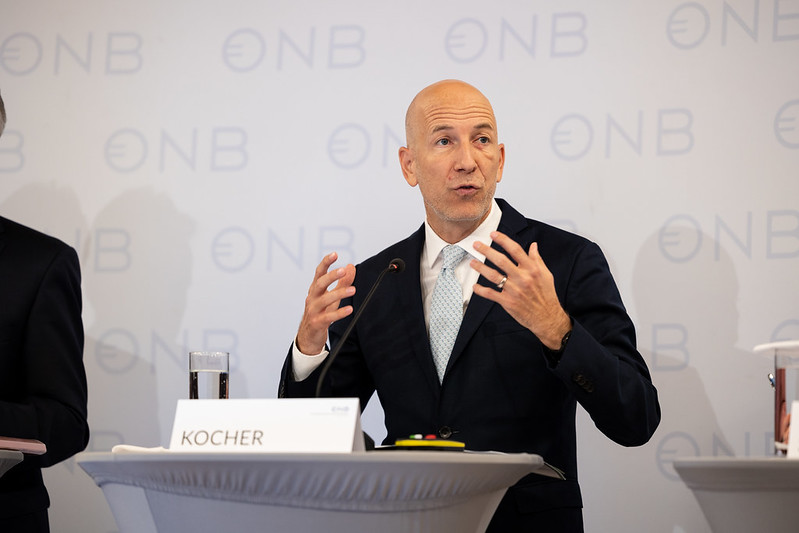
By David Barwick – FRANKFURT (Econostream) – European Central Bank Governing Council member Martin Kocher said Tuesday that another interest rate increase before the end of the year was likely if economic and inflation conditions remained unchanged, but emphasized that the ECB could not precommit to such a move given the high degree of uncertainty.
“If the situation does not change, if prices remain at their current level and if there are no other changes in the underlying conditions, then an interest rate increase this year is likely,” Kocher said in an interview with Austrian broadcaster ORF.
“However, given this uncertainty, I believe it is also fair to say that we do not know yet,” he added.
Kocher's comments followed a speech earlier Tuesday by Bundesbank President Joachim Nagel, who said that a December interest rate increase was very likely necessary and that there was unlikely to be any way around such a move unless the inflation outlook improved significantly.
Asked about Nagel's remarks, Kocher acknowledged the likelihood of further tightening under unchanged circumstances but stressed that developments before the ECB's December meeting remained uncertain, principally due to geopolitics.
Kocher defended the Governing Council's decision last Thursday to leave interest rates unchanged, following two increases earlier this year.
The ECB had raised interest rates in June and again in September before deciding last week that it was necessary to “wait a little longer and see how the situation develops,” he said.
“We will of course have to respond with monetary policy if necessary, but only if necessary,” Kocher said, observing that tighter monetary policy dampened economic activity.
Nevertheless, if necessary, the ECB would “do everything” to achieve its 2% inflation target over the medium term, he said.
Kocher said the current inflation shock was fundamentally different from one driven by excessive demand or an overheating economy. Rather than resulting from particularly strong economic activity, renewed inflation pressures reflected external factors, particularly higher energy prices stemming from the conflicts involving Russia and Ukraine and in the Middle East, he said.
Such developments were difficult for central banks to predict or influence directly, he said.
“At the moment, we assume that inflation will decline next year, but the inflation risk remains high,” Kocher said, emphasizing the need for continued vigilance.
He also pointed to the adverse scenario in the ECB's September projections, under which inflation could reach around 5% next year.
That would remain substantially below the inflation rates of around 8% to 10% experienced during the previous inflation surge, but would still be “far too high,” he said.
In such a scenario, monetary policy would have to respond more forcefully, Kocher indicated.
Kocher also discussed the impending departure of ECB President Christine Lagarde, emphasizing that the institution would remain fully capable of acting during the leadership transition.
“It is a personal decision by the president,” he said, arguing that what mattered was the stability of the ECB as an institution and of the Governing Council.
“There is absolutely no doubt about that,” he said, adding that the ECB was “fully capable of acting” during the transition.
Kocher credited Lagarde with having contributed significantly to building consensus among Governing Council members and expressed confidence that this would continue.
Asked whether the choice of Lagarde's successor would come down to the two leading candidates from the Netherlands and Spain, Kocher said there “can always be surprises.”
He noted that the Eurogroup would discuss the appointment next week and that the established procedure also involved consultation with the European Parliament and the ECB Governing Council before a final decision by European leaders.
However, Kocher acknowledged that the two leading contenders were candidates with “a great deal of experience.”