
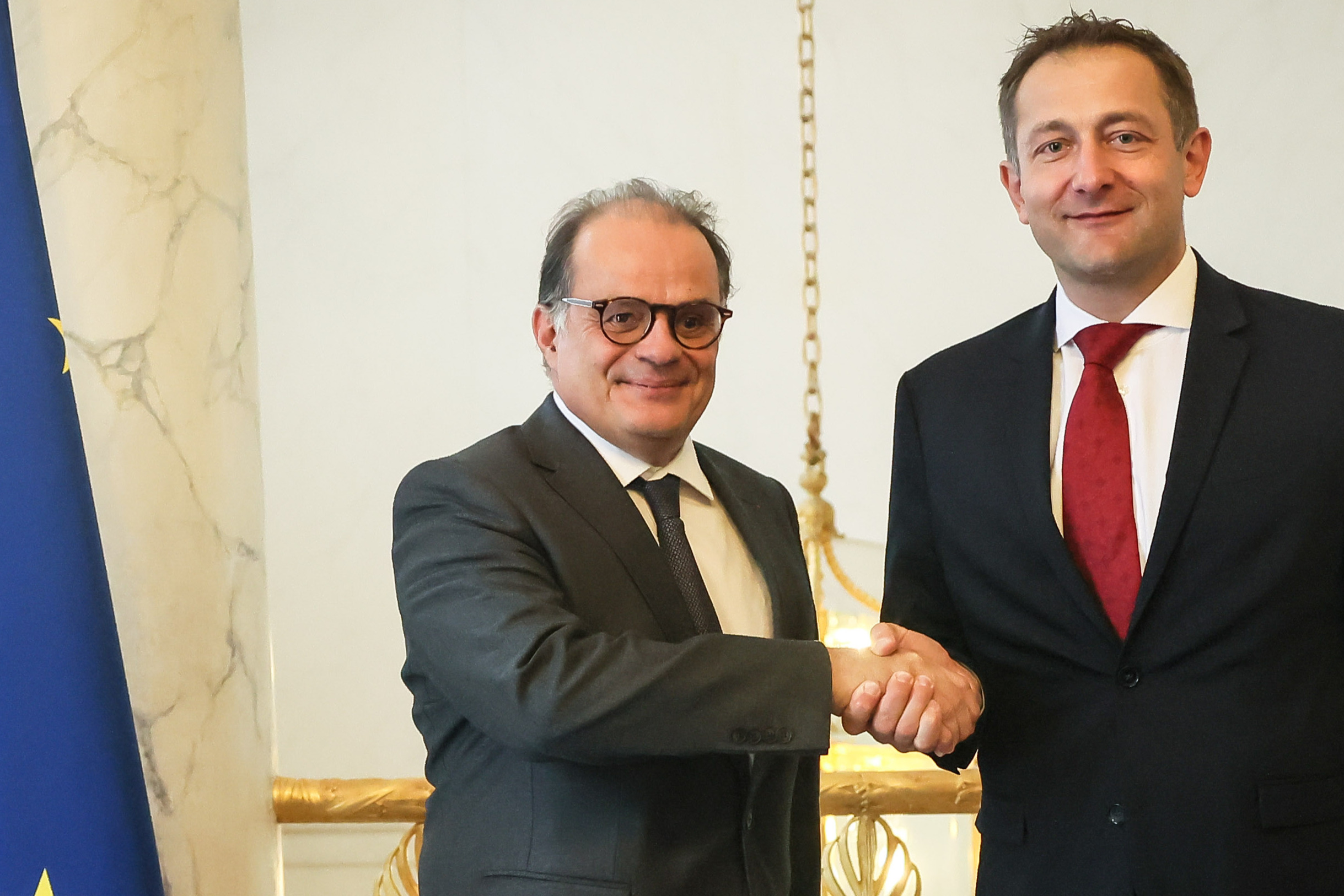
By David Barwick – BANGKOK (Econostream) – European Central Bank Governing Council member Emmanuel Moulin said Wednesday that the current energy-driven inflation shock warranted a “measured adjustment” of monetary policy, while higher long-term yields were already tightening financial conditions and could allow a more moderate interest rate response.
The Banque de France governor, speaking at an International Monetary Fund event in Bangkok, said the ECB could look through a limited and short-lived energy shock, while a larger inflation overshoot called for a measured policy adjustment and a significant, persistent deviation from target would require a more forceful response.
“I think we are in the second case at the moment,” Moulin said.
At the same time, the rise in long-term yields, partly reflecting developments in the United States, was tightening financial conditions across Europe and could affect demand, he said.
“This increase in yields is putting pressure on financial conditions,” Moulin said, adding that it “could lead us to have a more moderate response to the inflation shock” because higher yields were “also doing the job.”
Asked whether market pricing of three further rate increases was consistent with a good understanding of the ECB’s reaction function, Moulin declined to endorse that expectation.
“We are making decisions meeting by meeting and we’re data-dependent,” he said. “I will not comment on what the forecast of the market is.”
The ECB would assess the data and market developments before its next meeting at the end of October, he said, again pointing to the tightening of financial conditions caused by higher long-term interest rates.
Moulin said the inflation increase was mainly the result of the Middle East conflict and the associated energy shock, while indirect and second-round effects were expected to remain considerably more contained than during the 2021-2024 inflation episode.
Inflation excluding energy and food was therefore expected to rise only moderately, averaging 2.5% in 2026 and 2.6% in 2027 before declining to 2.3% in 2028, he said.
Medium-term inflation expectations among both companies and households were “well anchored,” Moulin said.
Headline inflation was projected at 3% this year, 2.5% in 2027 and 2.1% in 2028, meaning “we would be bringing inflation close to 2%, which is our target, by the end of the projection horizon,” he said.
Private-sector forecasts and inflation swap markets were consistent with that outlook, “implying that our projections and the strategy are credible,” Moulin said.
Turning to fiscal policy, Moulin said growth alone would not be sufficient to resolve the problems facing highly indebted countries.
“You cannot only grow out of fiscal issues,” he said. Action would also be required on spending and, in some cases, government revenue.
Germany had room for fiscal expansion and its increased infrastructure and defense spending would support both domestic growth and other economies through spillovers, Moulin said.
France, by contrast, faced a more urgent situation as higher yields were compounded by a wider spread over Germany, he said. Moulin argued that the recent market deterioration was not primarily the result of a sudden worsening in France’s underlying fiscal position.
“This is more linked to uncertainties regarding the vote of the budget and the political situation and the political uncertainty with the election coming up in April and May,” he said.
“I think it is urgent for those countries like France to show that they are committed to fiscal consolidation,” Moulin said, adding that the immediate priority was to secure a budget and honor commitments to reduce the deficit.
He also called for a broader political consensus around a declining deficit trajectory, saying this would create more room to finance priorities such as defense at a time when higher interest costs were constraining budgets.
Asked whether France could achieve the necessary fiscal adjustment given its scale, Moulin said previous episodes showed that substantial deficit reduction was possible.
“I think it’s totally possible to have this kind of adjustment without waiting too much on growth,” he said. “It needs to be multi-annual. It needs to be consistent.”
Primary spending was currently under control, Moulin said, but higher interest rates were adding almost €10 billion annually to interest costs, while tax revenues had become less dynamic.
Structural reforms would also be important, particularly pension reform, which Moulin said could simultaneously raise labor force participation and reduce age-related public spending.
More broadly, Moulin said Europe needed stronger investment in technology and greater diffusion of new technology in order to lift productivity, alongside further integration of its financial markets.
“We need to complete the savings and investment union,” he said, calling it “a key priority for governments.”
Europe should also complete banking union by removing remaining obstacles to the cross-border flow of liquidity and capital, Moulin said, adding that renewed merger and acquisition activity in the banking sector was positive for that process.
On energy policy, Moulin said Europe could do little directly about global oil prices beyond diplomatic efforts to help end the Middle East conflict, but should continue reducing its dependence on fossil fuels.
“The right thing is a combination of different sources of energy, not focusing on just one,” he said, pointing to investment in both renewables and nuclear power.
Reducing Europe’s exposure to fossil fuel prices was important not only for climate policy but also for economic resilience, Moulin said.