
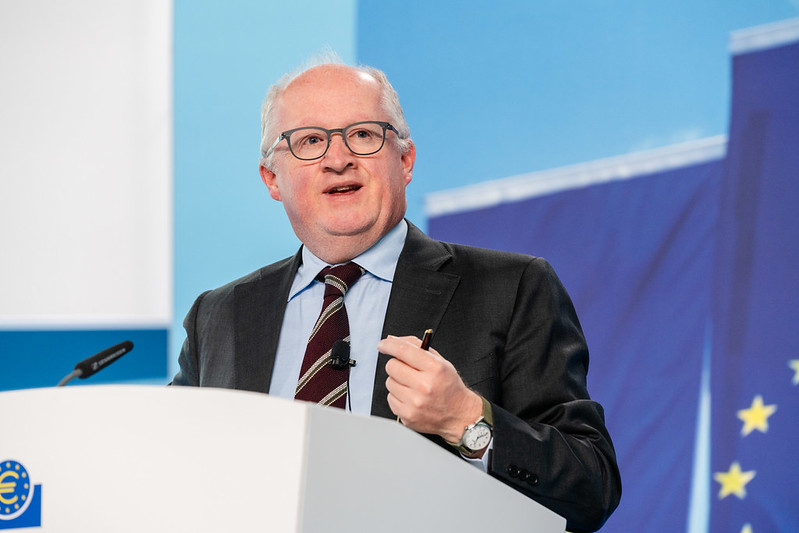
By David Barwick – FRANKFURT (Econostream) – European Central Bank Executive Board member Philip Lane said Tuesday that the global artificial intelligence investment boom was contributing to higher long-term interest rates, resulting in a material tightening of financial conditions in the euro area that was relevant to the ECB’s monetary policy stance.
In remarks prepared for the International AI Summit in Dublin, Lane said the comparatively smaller scale of AI investment in Europe meant the euro area was experiencing the interest rate effects of a much larger global boom without an equivalent domestic investment surge.
“[T]he global AI investment boom and expectations of a future global AI-driven productivity boost at longer-term horizons are plausibly contributing to the global increase in long-term interest rates,” Lane said.
“Especially since the scale of the European AI boom is not of the same order as the global AI boom, the spillover to the euro area bond market means that the increase in long-term interest rates constitutes a material tightening of financial conditions for the euro area,” he said. “This is a relevant factor for the ECB in determining the appropriate monetary policy stance.”
Lane said AI was nevertheless already supporting current euro area economic activity, with firms expected to devote around 10% of their total investment to AI this year, while AI-related lending accounted for roughly one quarter of recent credit growth to firms.
The ECB was monitoring AI partly because its medium- and longer-term impact on potential output and trend growth could “raise the speed limit of the economy, with direct implications for the financial system and monetary policy,” he said.
For Europe, AI's potential to offset the effects of the projected decline in the working age population was “especially valuable,” Lane said.
AI adoption was already significant and increasing rapidly, although it remained too early to identify a material effect on aggregate productivity, he said.
The ECB's latest surveys showed that 64% of firms were using AI either experimentally or moderately, while just 7% reported significant use. The proportion of workers reporting that they used AI at work had doubled to 52% over the last two years from 26%, Lane said.
“In the aggregate, workers are reporting significant time savings, but these are highly concentrated in specific sectors and specialised tasks such as coding,” he said.
The labor market effects remained limited at the aggregate level, but hiring plans were muted, particularly affecting new graduates, while AI's potential to replace some workers could weaken their bargaining power, moderate wage growth and reduce labor's share of income, Lane said.
Europe nonetheless remained well behind the United States and East Asia in the scale of its AI expansion. Digital investment in the United States had grown twice as fast as in the euro area over the last two years, while US workers spent two to three times as much of their working week using AI as workers in the largest euro area economies, he said.
Lane also pointed to financial stability risks stemming from high AI-company equity valuations and the global increase in AI-related debt issuance.
“[T]he high equity valuations of AI firms and the global surge in AI-related debt issuance carry macroeconomic and financial stability risks in the event of even a temporary reversal in the expected rate of AI advancement or a decline in investor sentiment,” he said.
The ECB's financial stability and banking supervision functions were therefore closely monitoring AI-related financial and cyber risks, Lane said.