
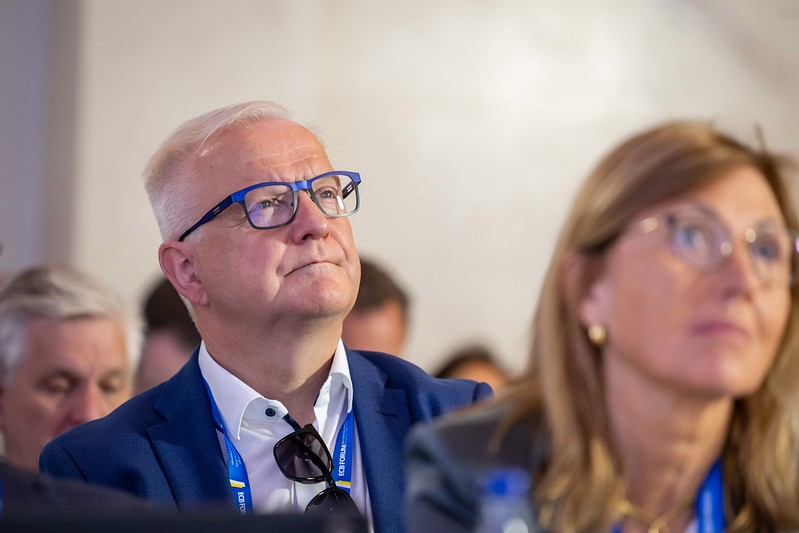
By David Barwick – FRANKFURT (Econostream) – European Central Bank Governing Council member Olli Rehn said Friday that the euro area inflation and growth outlook was being pulled in opposing directions by sharply higher energy prices and rising long-term interest rates, leaving the European Central Bank’s projections subject to unusually high uncertainty.
Rehn, speaking at the annual conference of the European Systemic Risk Board, said: “Higher energy prices bring us closer to the ECB’s adverse scenario in terms of inflation.”
“But, on the other hand, the rise in long-term interest rates will slow growth and reduce the pass-through of the energy shock to other prices and wages,” he said.
Rehn, who heads the Bank of Finland, said the combination underscored that the ECB’s projections for growth and inflation remained subject to “very high, pervasive uncertainty.”
The ECB’s September projections foresee euro area growth of 0.9% this year and 1.4% in 2027, while inflation is expected to decline from 3.0% this year to 2.1% in 2028, he noted.
Rehn also identified high and rising public debt across developed economies as a financial-stability concern, saying higher borrowing costs, growing spending needs and limited fiscal space could increase sovereign risks and expose vulnerabilities elsewhere in the financial system.
“These risks underline the need for continued vigilance and for sustained fiscal consolidation,” he said.
Rehn said the artificial-intelligence investment boom represented another potential source of financial instability, despite its potential to generate substantial long-run productivity gains.
Investment in computing capacity, chips and energy infrastructure was increasingly dependent on debt, including complex financing arrangements, he said.
“A sharp correction in AI-related valuations could spread through equity and credit markets,” Rehn said.
Turning to Europe’s longer-term financing needs, Rehn said the continent faced what he called a “triple test” of defense, energy and productivity, all of which would require substantial investment.
Europe had sufficient savings to finance those needs but lacked a sufficiently integrated financial market to channel them efficiently into productive investment, strengthening the case for completing the Savings and Investments Union, he said.
Rehn said a well-designed European safe and liquid asset could deepen capital-market liquidity, provide a benchmark for pricing bonds and derivatives, supply collateral usable across member states, attract global investors and strengthen the international role of the euro.
He cautioned, however, that any design would have to preserve incentives for fiscal discipline, distribute costs and benefits fairly enough to satisfy all member states and avoid creating new risks for national bond markets.
“In my view, the case for a European safe asset deserves further examination,” Rehn said.
But he stressed that policymakers should not assume that every possible design would improve financial stability or that a common safe asset was necessarily the answer to every problem facing European capital markets.
“It is not the task of the ESRB to settle the political choices concerning fiscal integration or risk sharing,” he said, adding that the board could instead assess the financial-stability implications of the available options.