
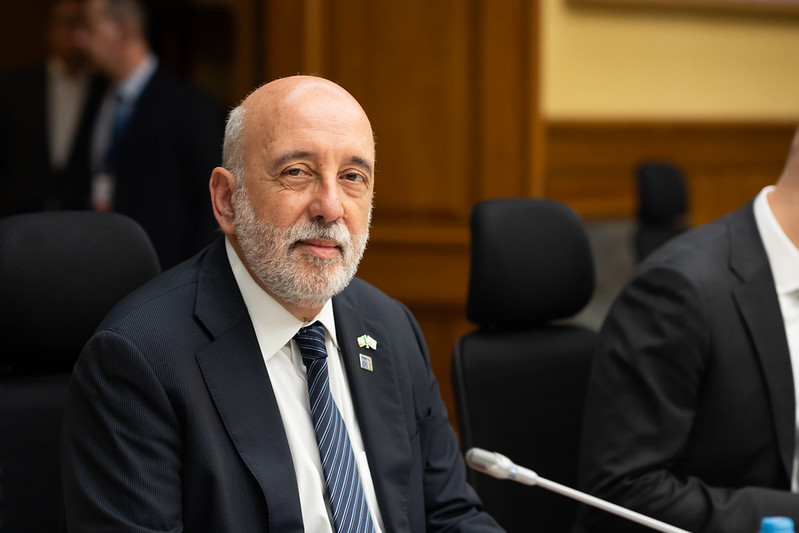
By David Barwick – FRANKFURT (Econostream) – Public money must remain at the center of the monetary system as payments become increasingly digital and tokenized, European Central Bank Governing Council member Gabriel Makhlouf said Friday, stressing the importance of preserving trust while allowing innovation.
Makhlouf, who heads the Central Bank of Ireland, told a conference in Dublin on the sidelines of the informal ECOFIN meeting that technological change was raising questions over settlement, redemption and interoperability as new providers and forms of payment became more prominent.
“Money has always been built on trust,” he said, arguing that the monetary system worked best when exchange could take place without fragmentation between issuers or platforms.
At the core of the existing two-tier system, “public money must continue to play the anchoring role,” Makhlouf said, with private money deriving its effectiveness partly from its convertibility into central bank money.
Keeping Eurosystem infrastructure and policy suited to a more digital financial system would require further development of both wholesale and retail central bank money, he said.
On the retail side, Makhlouf referred to “cash, and soon its digital equivalent, the digital euro,” saying both needed to remain available in order to underpin confidence that money retained a common value.
Private payment providers would remain equally important, according to Makhlouf, who said banks and newer entrants needed to be financially and operationally resilient while continuing to innovate within a framework focused on safety and soundness.
Competition could improve choice, quality and prices, he said, but warned that it would not necessarily resolve fragmentation caused by incompatible systems and competing standards.
Pointing to new Central Bank of Ireland research published Friday, Makhlouf said close to half of respondents under 35 used mobile wallets as their primary payment method, while three in five Irish adults used a digital or neobank alongside a more established bank.
Despite the rapid shift toward digital payments, consumers continued to put security, reliability, trust and fraud protection ahead of speed, convenience or cost when choosing how to pay, he said.
Trust in digital banks remained lower than in high-street banks, although Makhlouf said the gap was smaller among younger consumers.
For merchants, the Central Bank of Ireland estimated the private cost of processing retail payments at at least €1 billion annually, or around 0.3% of Irish modified gross national income, he said, with smaller businesses facing disproportionately higher per-transaction costs.
More efficient and integrated payments could also improve liquidity management, market access and international trade, Makhlouf said, while leaving existing frictions unaddressed carried economic costs.
Central banks and regulators would have an important role in shaping the future payments system, he said, with the objective of allowing new forms of payment to coexist with established ones while remaining interoperable, redeemable and trusted.
- The author of this story can be contacted at david.barwick@econostream-media.com